

BBSSL: Transforming India’s Seed Sector
Bharatiya Beej Sahakari Samiti Limited has established a strong national presence in cooperative seed business, achieving revenue of Rs 227 crore in FY 2025-26.

Ajeet Singh
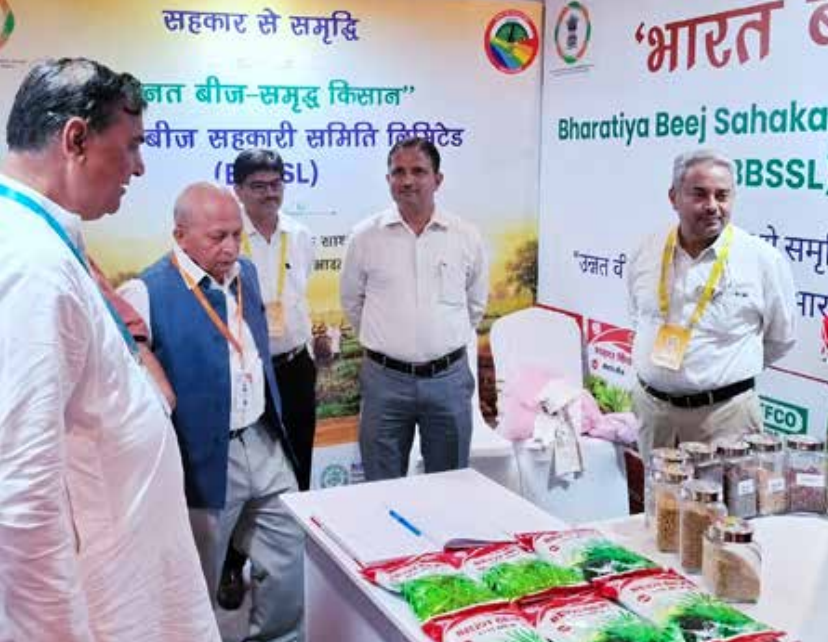
Established in 2023, Bharatiya Beej Sahakari Samiti Limited (BBSSL) is rapidly emerging as a key institution in India’s seed ecosystem. Formed under the initiative of the Ministry of Cooperation, the multi-state cooperative society aims to strengthen domestic seed production and provide farmers with high-quality seeds through an extensive cooperative network.
Promoted by five leading cooperative institutions, namely IFFCO, KRIBHCO, NAFED, NDDB and NCDC, BBSSL seeks to create a farmer-centric seed system that combines production, certification, processing, and marketing within a cooperative framework.
In an exclusive interaction with Rural World, BBSSL Managing Director Chetan Joshi said that the organisation recorded revenue of nearly Rs 227 crore in FY 2025-26, a remarkable jump from approximately Rs 55 crore in the previous financial year. During the year, BBSSL sold seeds across 14 states and supplied nearly twice the quantity of improved seeds compared to the previous year.
The cooperative has set an ambitious revenue target of Rs 600 crore for FY 2026-27. According to Joshi, BBSSL plans to expand seed sale to farmers in every state through government-supported seed distribution programs and a growing retail network. Another major objective is the conservation and promotion of indigenous and traditional seed varieties.
A Year of Significant Growth
The financial year 2025-26 marked a milestone in BBSSL’s journey. The organisation sold nearly 32,000 tonnes of seeds covering 15 crops across the country. For FY 2026-27, it has set a target of selling 76,000 tonnes of seeds spanning 27 crops.
Within only three years of its establishment, BBSSL has developed a robust system for seed production, procurement, and marketing. The organisation currently holds seed marketing licenses in 17 states and plans to expand its licensed distribution network to additional states during the current financial year.
Among all crops, wheat accounted for the largest volume of seed sale during FY 2025-26, with 17,583 tonnes sold to farmers. Groundnut seed ranked second at 7,036 tonnes, followed by paddy seed at 2,968 tonnes.
From a revenue perspective, groundnut seed generated the highest income, contributing approximately Rs 88 crore. Wheat seed generated around Rs 67 crore, while paddy seed contributed nearly Rs 11.7 crore. BBSSL also supplied pulses seeds to farmers, helping strengthen domestic production of key food crops.
The largest volumes of BBSSL seeds were sold in Uttar Pradesh, Gujarat, Madhya Pradesh, Rajasthan, and Maharashtra. Joshi said the organisation plans to expand its licensed distribution network further across southern and northeastern states to ensure wider access to quality seeds.
Building a Cooperative Seed Ecosystem
One of the distinguishing features of BBSSL is its cooperative-based seed production model, which directly involves farmers and rural institutions in the seed value chain.
According to Joshi, more than 37,000 Primary Agricultural Credit Societies (PACS), Farmer Producer Organizations (FPOs), and other cooperative institutions have already become members of BBSSL. In terms of membership, BBSSL is the largest cooperative society in the country.
The model integrates seed production, processing, certification, storage, and marketing under a cooperative framework. This not only helps create a reliable seed supply system but also provides farmers with opportunities to earn additional income by participating in seed production activities.
Farmers gain access to quality seeds through government-supported seed distribution schemes as well as retail outlets. For seed multiplication, breeder seeds are sourced from the Indian Council of Agricultural Research, state agricultural universities, and leading national and international research institutions.
The cooperative approach is designed to strengthen self-reliance in seed production while reducing dependence on external sources and ensuring that farmers receive certified, high-performing varieties.
Focus on Climate-Resilient Agriculture
As climate change increasingly affects agricultural production, BBSSL is placing strong emphasis on the development and promotion of climate-resilient seed varieties.
The organisation is focusing on varieties that are tolerant to climatic stresses, resistant to pests, and capable of withstanding major diseases. Improving the Seed Replacement Rate (SRR) and Variety Replacement Rate (VRR) also forms an important part of its strategy.
To enhance transparency and traceability, BBSSL is introducing QR code-based systems that enable tracking of seed origin and quality throughout the supply chain. Such measures are expected to improve farmer confidence and strengthen quality assurance mechanisms.
Investing in Research and Innovation
Research and innovation have become central pillars of BBSSL’s long-term strategy. To accelerate seed research and technology development, the cooperative is establishing a state-of-the-art seed research centre in Kalol.
For this initiative, BBSSL has signed a memorandum of understanding with International Crops Research Institute for the Semi-Arid Tropics (ICRISAT) as its knowledge partner. The collaboration is expected to support research on improved crop varieties, sustainable seed technologies, and climate-resilient agriculture.
The organisation has also decided to establish tissue culture laboratories for banana cultivation in East Godavari in Andhra Pradesh, Jalgaon in Maharashtra, and Barabanki in Uttar Pradesh. These facilities will help provide farmers with disease-free planting material and improve productivity in banana cultivation.
Similarly, BBSSL has partnered with Banas Dairy to promote the production of high-quality potato seeds. The partnership will leverage tissue culture and aeroponic technologies to enhance the availability of superior potato planting material.
Empowering Farmers Through Ownership
For BBSSL, cooperation is more than a business model. It is a mechanism for giving farmers a greater stake in agricultural development.
“Farmer participation is essential for building a self-reliant and sustainable seed system,” says Joshi. By integrating farmers into the seed production process and strengthening cooperative institutions, BBSSL aims to create a resilient seed ecosystem that delivers long-term benefits to Indian agriculture.
As the cooperative expands its footprint across the country, its broader vision extends beyond seed production and distribution. The goal is to build a trustworthy, farmer-owned, and innovation-driven seed ecosystem capable of supporting India’s food security, agricultural competitiveness, and rural prosperity in the decades ahead.
RNI No: DELBIL/2024/86754 Email: [email protected]