

India's Fertilizer Crossroads From Crisis to Competitive Advantage
Amid a Rs 1.86 trillion fertilizer subsidy bill, rising import dependence, and declining soil fertility, India needs a fundamental overhaul of its fertilizer policy

Yashpal Singh Saharawat

Dr. Padma Shanthi
The Big Picture
How India Feeds 1.4 Billion People and Why That's Under Threat
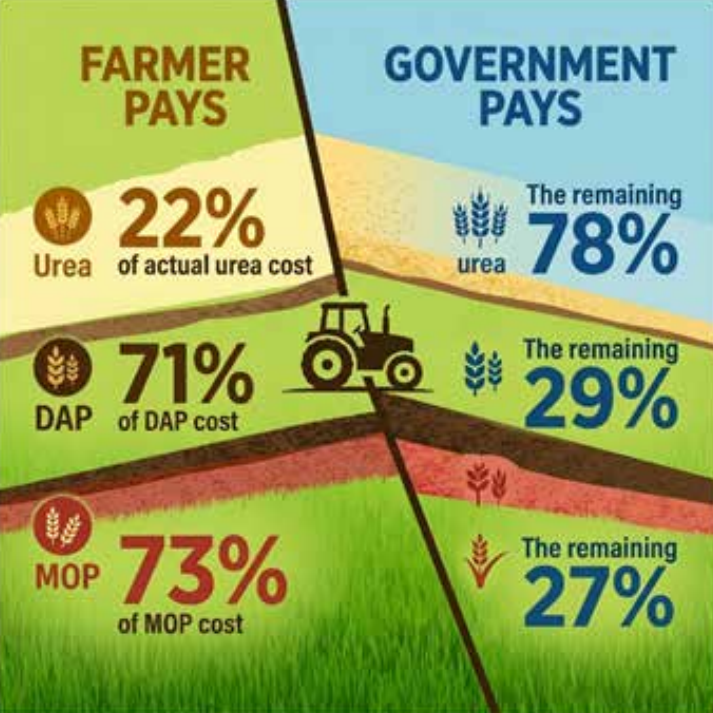
Let's start with a simple question: When a farmer walks into a fertilizer shop in Punjab or Bihar, what does he buy? Most likely, a bag of urea. Why? Because it costs him just Rs.260 - 300 for a 45 kg bag, around 22% of global market cost. The government pays the rest.
This system has been working for decades. India's foodgrain production has jumped from 51 million tonnes in 1950-51 to over 377 million tonnes today. We now feed 1.4 billion people, no small feat.
But here's the problem. That cheap bag of urea comes with a hidden price tag that keeps growing every year.
Meet Gurpreet Singh, a farmer in Punjab's. He owns 5 acres and grows rice and wheat. Every season, he applies urea, sometimes 20-40% more than what agricultural scientists recommend. Why? Because it's cheap, it's available, and his father did the same.
"If urea is so cheap, why wouldn't I use more? More urea means more crop, right?" — Gurpreet's thinking, shared by millions of Indian farmers
Wrong, say the scientists. India's Nitrogen Use Efficiency is just 30-35%, one of the lowest in the world. That means nearly two-thirds of every rupee spent on nitrogen fertilizer is literally wasted. It doesn't feed the crop. It pollutes the water, poisons the air, and damages the soil.
What India Spends on Fertilizer
The government's total fertilizer subsidy bill? Over Rs.1.86 lakh crores in FY 2025-26. To put that in perspective: for every Rs.1,000 the government spends on sustainable agriculture, it spends Rs.1,00,000 on fertilizer subsidies.
The Invisible Crisis
India imports 100% of its potash, 60% of its phosphate, and about 20% of its nitrogen, either as finished products or raw materials. And nearly 90% of these imports pass through the Strait of Hormuz, a narrow waterway in the Middle East.
What happens if that route gets blocked? A six-month disruption could:
• Force farmers to ration fertilizers
• Push food prices through the roof
• Cost the government an extra Rs.40,000-60,000 crores in emergency subsidies
• Undo decades of food self-sufficiency
This isn't scaremongering. The 2022 fertilizer crisis, triggered by the Russia- Ukraine war, was a warning shot. India survived only because of existing stockpiles and strategic maneuvering.
The Real Cost Of Cheap Fertilizer
Meet Savitri Devi from Haryana
Savitri Devi has been farming 3 acres in Haryana for 20 years. She grows paddy and wheat. For years, she followed the standard recipe: one bag of urea after transplanting, another after a month, and a third if the crop looked yellow.
Last year, she noticed something strange. Her soil was turning hard. The water she pumped from her borewell tasted strange — salty. The crop wasn't responding to urea the way it used to.
She's not alone.
What's Happening to India's Soils?
• Nitrogen surplus in Indian soils has jumped from 17 kg per hectare in 1960s to more than 100 kg per hectare now
• In Punjab, soil organic carbon, the lifeblood of fertile soil has fallen to just 0.3-0.4%, average of India 0.47%
• Nitrate in groundwater has been rising since 1975. In Punjab, around 30%of the fertilizer nitrogen applied ends up in the groundwater
Here's what that means: Today's farmers are using more and more fertilizer to get the same yield. It's like a patient needing higher doses of medicine because the old dose stopped working. But this medicine is poisoning the water and the soil.
The Nutrient Imbalance
India has a strange problem. Urea (nitrogen) is heavily subsidized, farmers pay just 22% of the international price. But phosphate (DAP) and potash (MOP) are less subsidized, farmers pay 71% and 73% of the market price.
What do farmers do? They buy more urea because it's cheap, and skip DAP and MOP because they're expensive. The result:
• In Punjab, Haryana, western Uttar Pradesh, and Telangana, farmers apply 50-70% more nitrogen than recommended
• But they apply less phosphate and potash than needed
• The soil gets addicted to nitrogen. Other nutrients run low. Yields start falling.
Think of it like this: Imagine a diet where you eat only rice, plenty of it, but skip vegetables, dal, and milk. You'd get sick eventually. That's what India's soils are going through.
Why This Hurts Small Farmers
More than 53% of all fertilizer used in India is applied by farmers with less than 2 hectares of land. These are the poorest farmers. They spend a huge chunk of their income on fertilizers. When yields drop and input costs rise, they're the first to get squeezed.
"Every 46 kg increase in fertilizer use per hectare reduces rural poverty by 6%."- Sapkota & Bijay-Singh (2025)
But the reverse is also true: if fertilizer becomes more expensive without alternatives, millions of small farmers could be pushed into deeper poverty.
The Solution: Intelligent Farming, Not Less Farming
From 4R to 8R: A New Way to Think About Fertilizer
For years, experts have talked about the 4R approach to fertilizer: Right Source, Right Rate, Right Time, Right Place. It's good advice, but it's not enough.
India needs to go further, to an 8R Systems Approach that adds:
• Recycle- Turn crop waste, urban & rural waste, cow dung, and even city garbage into plant nutrients
• Rebuild- Restore soil health, not just feed the crop
• Record- Use digital tools to track what each field actually needs
• Resilient- Build supply chains that can survive global crises
Let's Look at What Works
Case Study 1: The Muzaffarnagar UP Model
In Muzaffarnagar, UP, a pilot project set up one small unit serving different states in India. The unit collects:
• Sugarcane bagasse (waste from sugar distillery)
• Spent Wash (Waste from distillery)
• Local synthetic fertilizers and organic sources
It converts this waste into standardized organo-mineral fertilizer sold at 20-30% cheaper than imported DAP.
The result? Farmers who used this fertilizer reported 12-15% higher yields in acid soils. Their input costs dropped. The air in their villages got cleaner because farmers stopped burning crop waste.
The question: Why aren't there 500 such units across India?
Case Study 2: What If Urea Could Actually Reach the Roots?
Most Indian farmers broadcast urea, they scatter it on the field surface. About 40-50% of it never reaches the plant roots. It evaporates into the air or washes into groundwater.
A technology called Mechanized Fertilizer Deep Placement (M-FDP) places fertilizer in small briquettes, 7-10 cm deep in the soil, right near the roots. A single machine does both, plants the crop and places the fertilizer. See the examples in Karnal Haryana, Assam, Odisha state.
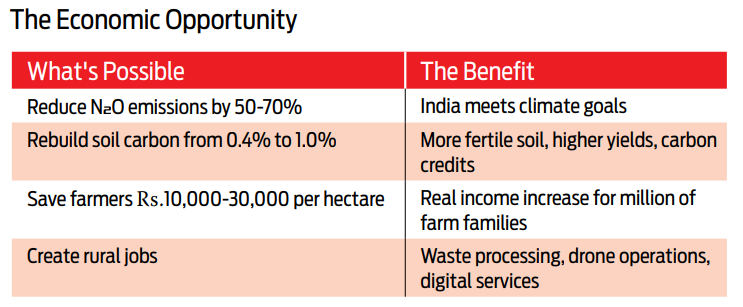
The savings? Farmers need 20-30% less fertilizer for the same yield. That's Rs.20,000-30,000 per hectare saved. For a farmer with 5 acres, that's real money.
Case Study 3: Precision Farming in Karnataka
Near Bangalore, a group of 50 farmers adopted IoT-based soil sensors linked to a mobile app. The app tells them exactly how much fertilizer to apply, and when.
• Yields increased by 18-22%
• Fertilizer costs dropped by 25%
• One farmer reported: "Earlier, I used to guess. Now the phone tells me."
The challenge? The hardware costs Rs.15,000-20,000 per hectare, and reliable internet is still patchy in rural India.
Government Schemes That Can Change Farming
Namo Drone Didi Scheme
Launched by Prime Minister Narendra Modi on 30 November 2023, this scheme trains women from Self-Help Groups as drone pilots for precision agriculture.
Imagine this: A drone flies over a wheat field, takes pictures, and within minutes tells the farmer which parts of his field need more fertilizer and which need less. The same drone then sprays exactly the right amount, no waste, no runoff.
This scheme can be the backbone of precision fertilizer application, if it's properly linked to Soil Health Cards and nutrient management systems.
Pm Pranam
The PM Program for Restoration, Awareness Generation, Nourishment, and Amelioration of Mother Earth (PM PRANAM) rewards states that reduce chemical fertilizer use.
How it works: If a state cuts its urea consumption by 10%, the money saved in subsidies goes back to the state for investments in alternatives- compost units, biofertilizers, farmer training.
The challenge: The scheme needs teeth. Currently, incentives are modest. For real change, states need stronger financial rewards tied to measurable soil health improvements.
Soil Health Card Scheme
Since February 2015, the government has distributed over 200 million Soil Health Cards, essentially a health report for each farmer's field. But here's the ground reality: Many farmers get the card, look at it, and don't understand what it says. The soil samples are often collected arbitrarily. The labs are overburdened.
The fix: Link each Soil Health Card to a mobile app (IFDC’s Space to Place Approach) that tells the farmer in simple language:
• "Your soil needs more potash"
• "Use 20% less urea this season"
• "Try mixing organo-minerals with your fertilizer"
VISTAAR & Agristack
VISTAAR and Agristack are India's digital agriculture platforms.
The vision: Every farmer gets a digital ID linked to their land, soil health data, and weather information. When a farmer needs fertilizer, the system recommends the exact blend, and the subsidy goes directly to their bank account (A IFDC’s Space to Place Approach for implementation).
No more guesswork. No more wasteful subsidies.
Promotion of Natural Farming & Organic Fertilizers
India is promoting natural farming methods like Zero Budget Natural Farming. But the transition from chemical fertilizers to organic alternatives isn't simple. Farmers need scientifically tested products that work.
Organo-mineral fertilizers- a blend of organic waste and mineral nutrients, offer a middle path. They rebuild soil health while giving crops the nutrients they need. The pilost proves they work and are cheaper than imports.
Direct Benefit Transfer (DBT)
Today: The government subsidizes products, mainly urea. The subsidy goes to consumers and fertilizer companies, not farmers.
Tomorrow: The subsidy should go directly to farmers based on what their soil actually needs. If a farmer's soil test shows low potash, the subsidy should encourage buying potash, not more urea.
The farmer gets cash in his bank account. He chooses the fertilizer. Market forces drive efficiency and innovation.
Climate, Carbon, And Cash
How Farmers Can Earn Money by Saving the Planet
Meet Vikas, a farmer from Haryana. He's been using conservation agriculture — a a regenerative agriculture practices that supplies slow plant nutrients by keeping residue on soil surface, improves soil health, reduces GHGs. It holds water in his field, reduces his fertilizer needs by 20%, and locks carbon in the ground for decades.
Carbon farming could pay him Rs.5,000-10,000 per hectare through international carbon markets. That's on top of the savings from using less fertilizer.
Green Bonds: Paying for Transition
India needs to build:
• Biochar plants that turn crop waste into carbon-sequestering fertilizer
• Organo-mineral facilities that process city and farm waste
• Strategic fertilizer reserves at ports and inland locations
Green bonds, loans from investors who want climate-friendly projects, can fund this infrastructure. International climate funds and ESG-conscious investors are eager to participate.
The Big Ask: Divert 5% Of Subsidy Funds To Innovation
A Simple Math Problem
India spends over Rs.1.8 lakh crores every year on fertilizer subsidies. The vast majority of this money goes to century-old products, urea, DAP, MOP — that haven't changed in decades.
Government of India need to divert just 5% of that amount, roughly Rs.7,500-9,000 crores per year, to a new National Fertilizer Innovation and Efficiency Fund.
Where the Money Should Go
• A world-class Fertilizer Innovation Centre that develops next-generation fertilizers- slow-release, coated, biodegradable, partically acidulated products, nano, bio-based, tailor-made for Indian soils- IFDC working with Odisha Government and private sector fertilizer industry to develop the first of Its kind Fertilizer Innovation Center in India
• 500+ local organo-mineral units across districts, turning village waste into village wealth and bring back urban waste as essential plant nutrients based products
• Precision agriculture tools- drones, soil sensors, mobile apps, Space to Place Approach, linked to Namo Drone Didi and Soil Health Cards
• Training 100 millions of youth, gender and farmers in smart fertilizer use through VISTAAR and Agristack
• Carbon farming certification so farmers get paid for rebuilding soil
• Domestic manufacturing of enhanced efficiency fertilizers through joint ventures
"Every rupee spent on innovation today saves multiple rupees in subsidy tomorrow."
What Needs To Happen Now
A 12-Month Action Plan
1. Set up the Fertilizer Innovation Centre A partnership between government, private companies, and global experts (including IFDC) to invent the fertilizers of tomorrow- today.
2. Launch 50 local fertilizer units as proof of concept Each unit turns local waste into local fertilizer.
3. Make Soil Health Cards actually useful Link every card to a mobile app that speaks the farmer's language. Connect it to VISTAAR and Agristack so every farmer gets personalized advice.
4. Start the 5% diversion Not next year. Not in five years. Now.
5. Issue green bonds For building regenative Ag. & biochar plants, composting facilities, and strategic fertilizer reserves.
6. Test DBT-based fertilizer subsidy in 100 districts Give farmers cash in their bank accounts instead of subsidizing products. Let them choose what their soil actually needs.
7. Expand Namo Drone Didi Every drone operated by a woman Self-Help Group should also be a precision fertilizer tool.
8. Give PM PRANAM real teeth Link state-level rewards directly to measurable soil health improvements and later with Bharat Soil Health Policy Matrix.
9. Launch carbon farming pilots Pay farmers for rebuilding soil carbon. Link to international carbon markets.
The 10-Year Vision: India as a Global Agricultural Innovator
Today: India imports 60% of its phosphate, 100% of its potash, and wastes two-thirds of its nitrogen. Its soils are degrading, its water is polluted, and its farmers are trapped in a cycle of rising input costs.
2035: India produces its own fertilizers from its own resources. Its farmers use smart tools- drones, sensors, apps to apply exactly what's needed. Its soils are healing, carbon is being locked underground, and farmers' incomes are rising.
This is not a dream. The technology exists. The economics work. The only missing ingredient is the enabling policy that allow to spend 5% of the subsidy budget on innovations and soil health
A Final Word to Every Indian
The next time you eat a roti or a bowl of rice, remember: that grain was grown with fertilizer that cost the nation more than just money. It cost us our groundwater quality. It cost us our soil health. It cost us our strategic independence.
But it doesn't have to be this way. India can feed itself AND restore its soils. India can support its farmers AND reduce its import dependence. India can grow more AND pollute less.
The path is clear. The opportunity is immense. The time to act is now.
RNI No: DELBIL/2024/86754 Email: [email protected]