

From Import Dependency to National Resilience in Fertilizers
Understanding India's fertilizer challenge: crisis assessment, geopolitical vulnerabilities and strategic framework

Yashpal Singh Saharawat

Dr. Padma Shanthi
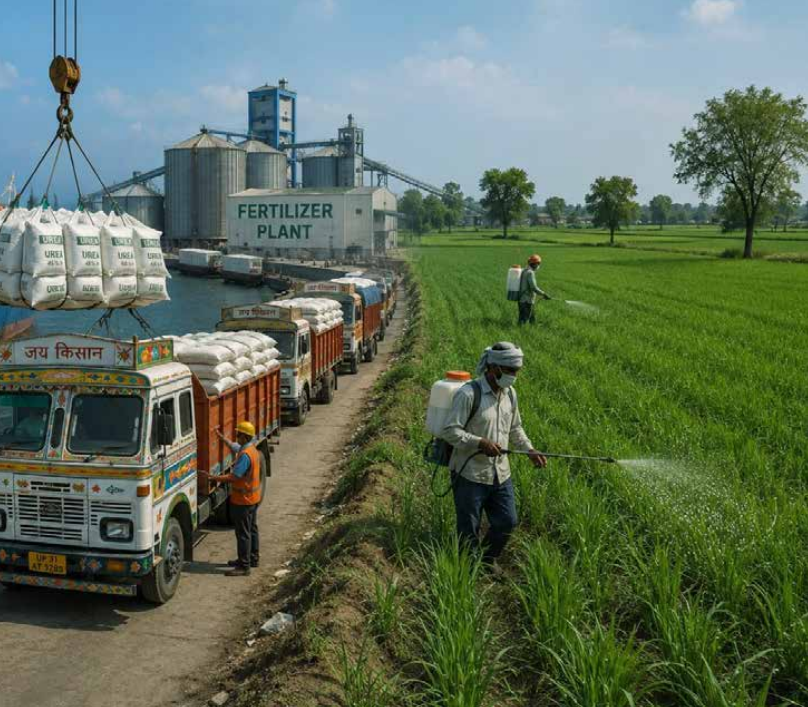
India's agricultural success, with foodgrain production rising from 51 MT in 1950-51 to 377 MT in 2025-26, masks a critical vulnerability: extreme import dependence on fertilizers. The nation imports approximately 20% of nitrogen, 60% of phosphorus, and 100% of potash fertilizers in finished or raw material form, alongside substantial volumes of ammonia, phosphoric acid, sulfur, and finished fertilizer products from various countries globally, creating cascading risks to food security, energy independence, and geopolitical sovereignty. This supply chain dependence exposes India to severe vulnerabilities through critical maritime chokepoints, particularly the Strait of Hormuz, which threatens the nation's ability to sustain domestic agricultural production and maintain economic stability. The extreme import dependency masks fundamental vulnerabilities in the agricultural sector that demand urgent strategic intervention to transition from import reliance to national resilience. The nexus between fertilizer availability, geopolitical chokepoints, and food security creates a complex vulnerability that undermines India's capacity to ensure long-term food production and maintain sovereign resilience. There is an urgent need to develop a comprehensive strategic framework that addresses geopolitical vulnerabilities, diversifies supply chains, and enhances domestic production capacity to safeguard India's agricultural future and sovereign resilience against global disruptions.
Strategic Reality:
The Strait of Hormuz, a 33-kilometer waterway between the Persian Gulf and Gulf of Oman, is the vital maritime artery for global energy and fertilizer trade, transiting 20% of seaborne fertilizers, 46% of nitrogenous fertilizers, and 20-25% of the world's liquefied natural gas annually. For India specifically, the Strait is critical: 87% of crude oil imports, 60-70% of natural gas imports, India imports 2.0-2.5 million tonnes of phosphate rock yearly (45-50% through the Strait) and 2.2-2.5 million tonnes of potash annually. Domestic urea production stands at 28-32 million tonnes annually but requires 8 to 10 million tonnes of imports, with natural gas comprising around 70% of manufacturing costs for the 28.4 million tonne capacity of gas-based plants. Disruptions cause 15-25% price spikes within 2-4 weeks, and short-term disruptions create a significant impact including urea price spikes and increased subsidy burdens. Medium-term disruptions (1-3 months) jeopardize the rabi sowing season fertilizer demand and may have significant adverse impact on nationwide foodgrain production. Extended blockades (6+ months) pose critical challenge to fertilizer availability and access causing serious challenges to food security, domestic fertilizer sector production, soil nutrient mining, and land degradation. Cascading crisis impacts include import parity price shocks for urea, DAP, and MOP that make fiscal subsidies untenable, fertilizer rationing to farmers, severe curtailment of production in gas-based urea plants, and inflation spirals that accelerate food market inflation and broader economic instability. A longer Strait disruption would create significant shortages in nitrogen, phosphate and potash, increase fertilizer costs, and require government subsidy increases of Rs.40,000-60,000 crores over the current Rs.1.86 trillion. Such disruptions would undermine decades-long food self-sufficiency efforts, expose strategic vulnerability, and cause severe and irreversible damage to soil productivity through prolonged nutrient mining, fundamentally jeopardizing India's agricultural foundation and food security.
India's Current Fertilizer Landscape: Consumption Patterns and Market Structure
India stands as the world's second-largest consumer of fertilizers, with annual NPK consumption exceeding 32 million tonnes in 2025-26, underpinning its position as a global agricultural powerhouse. However, the market exhibits significant structural imbalances, dominated by four primary products—urea (commanding >70% of nitrogen-based fertilizers), diammonium phosphate or DAP (>60% of phosphorus fertilizers), muriate of potash or MOP (>65% of potash fertilizers), and single superphosphate, creating a narrow product portfolio that constrains nutrient optimization. These dominant products, developed around a century ago, are water-soluble traditional fertilizers that remain largely unchanged despite significant advances in fertilizer and agronomic science. This reliance on old formulations directly underpins India's fertilizer use efficiency of merely 30-40%, the lowest globally, meaning that approximately two-thirds of applied nutrients are wasted rather than uptaken by crops. Despite consuming >32 million tonnes annually with per-hectare NPK application rates of 162 kg/ ha, India remains significantly below agronomically comparable regions.
The Declining Efficiency Crisis: A Six-Decade Collapse
The trajectory of India's fertilizer productivity reveals an alarming decline that directly challenges long-term food security. Historical data spanning six decades illustrates this deterioration:
This data reveals a sobering pattern: as fertilizer applications have increased nearly 80-fold since the 1960s, yield response per unit of fertilizer has collapsed by 85-90%, indicating severe nutrient saturation, inefficient uptake, and diminishing agricultural returns. Nitrogen use efficiency (NUE) has declined from >50% in the 1970s to <35% today, with approximately 65% of applied nitrogen lost to the environment. India now ranks below China, the USA, and most Southeast Asian nations for NUE, a position incompatible with global agricultural competitiveness and sustainability. The economic costs are staggering- massive government subsidy burdens, groundwater contamination from nitrogen leaching, soil degradation from chemical accumulation, air pollution from ammonia volatilization, and significant climate contributions from nitrous oxide emissions threaten both farm viability and public health.
Soil Health Degradation: The LongTerm Crisis
The massive inefficiency of India's fertilizer system has precipitated a cascading soil health crisis, documented through Soil Health Card data across millions of farm plots:
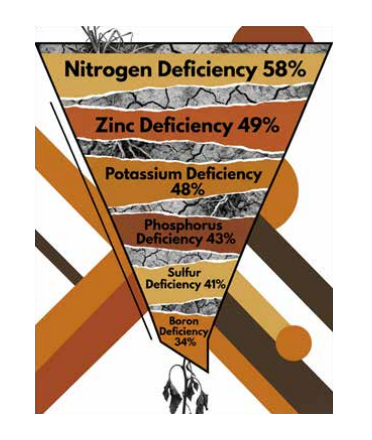
Root Causes of Soil Degradation
The paradox of declining soil health despite increasing fertilizer use stems from systemic imbalances:
Imbalanced fertilization: Heavy urea reliance creates nitrogen oversaturation while neglecting phosphorus, potassium, sulfur, zinc, and boron, micronutrients critical for crop quality, pest resistance, and soil microbial health.
Loss of organic matter: Declining adoption of composting, green manuring, crop rotation, and farmyard manure use has eroded the soil's organic carbon content, the foundation of soil structure, water retention, and nutrient cycling capacity.
Soil degradation cascade: The depletion of organic matter reduces microbial activity and weakens soil structure, impairing water and nutrient retention. This reduced resilience increases crop vulnerability to drought, pests, and diseases. Simultaneously, soil acidity, salinity, and nutrient imbalances accumulate, creating a self-reinforcing cycle of degradation.
The Unsustainable Trajectory
This trajectory is fundamentally incompatible with India's food security objectives. Higher fertilizer application rates now produce diminishing or even negative returns on yield while simultaneously poisoning soil, water, and air. The massive wasting of nutrients (approximately two-thirds of applied fertilizers) creates cascading environmental and health consequences: contaminated groundwater threatens drinking water security across agricultural regions, accumulated salts degrade soil structure, nitrous oxide emissions contribute to climate change, and ammonia volatilization degrades air quality and human respiratory health. Without urgent transition toward modern, efficient, balanced, and organic-matter-enhancing nutrient management systems, India's agricultural productivity will continue its decline, food security will deteriorate, and environmental and health externalities will intensify across the One Health spectrum.
Current Fertilizer Realities & Operational Constraints
Production Capacity vs. Import Dependency
India's domestic urea capacity (28.4 MT/year) depends entirely on LNG imports via the Strait of Hormuz, a geopolitical chokepoint. Phosphate availability is severely limited, with 59% of DAP imported despite possessing 300+ MT rock phosphate reserves (45 MT commercially usable). Most critically, potassium shows 100% import dependence despite holding 2 billion tonnes of untapped glauconite deposits, classified out of the Mineral Concession Rules and therefore unexploited.
Subsidy Burden & Fiscal Impact
The product-based, urea-centric subsidy system allocates Rs.1.86 lakh crore annually. During supply disruptions, costs escalate exponentially rather than linearly. Current fiscal architecture is mathematically unsustainable beyond 5-7 years without fundamental structural reform. The system creates unreasonable incentives, farmers apply urea 20-40% above agronomic requirements, driven by artificially cheap prices, compounding soil degradation while failing to achieve efficiency gains.
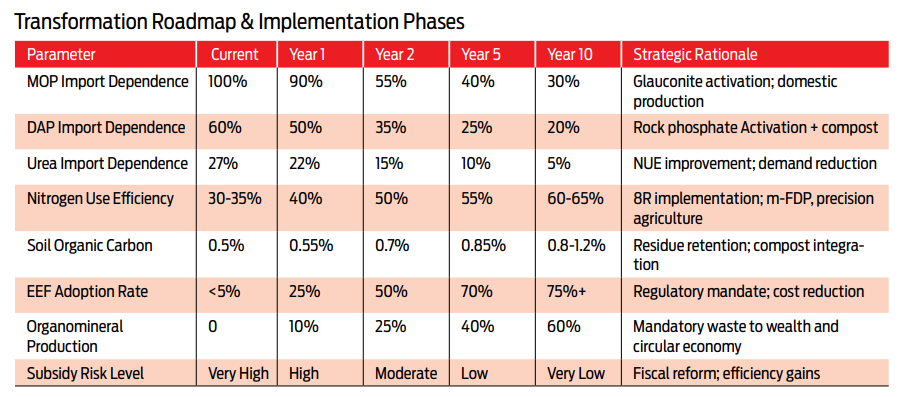
Strategic Objectives and 8R Framework: A Three-Phase Transformation Roadmap
Immediate Priority (0–12 months):
Through strategic local resource utilization and buffer stocks, and supply diversification approve and implement
Enhanced Efficiency Fertilizers (EEF) deployment,
Mechanized Fertilizer Deep placement,
converting local waste to organo-minerals,
Reduce import vulnerability by 15-20%
This will build operational capacity and political consensus for deeper reforms.
Medium-Term (12–24 months): Activate,
Domestic mineral resources (rock phosphate upgrades, glauconite classification),
Pilot- soil health card based fertilizer allocation in high fertilizer use districts,
Promote alternative fertilizer manufacturing locally,
Scale decentralized production systems (organo-minerals) to 50 districts.
Mandate fertilizer deep placement and integrated nutrient management in 300+ districts.
All the above interventions will enable to achieve 30-40% import substitution.
Long-Term (2–10 years): Establish Fertilizer Innovation Centre. Build geopolitically insulated, climate-adaptive system. Reduce subsidy burden to Rs.40,000-50,000 crore annually and Achieve 70%+ nutrient self-sufficiency.
8R Framework:
Evolution Beyond 4R
Traditional 4R (Right Source, Right Rate, Right Time, Right Place) must expand to 8R by adding four critical dimensions:
Recycle: Close nutrient loops through circular economy; substitute 25-40% of synthetic inputs with recovered nutrients
Rebuild: Restore soil organic carbon from 0.5% to 0.8-1.2%; rebuild soil structure and biological activity
Record: Deploy IoT + AI for real-time monitoring; enable precision calibration at plot level
Resilient: Diversify supply across sources, geographies, and modalities; eliminate single-point failures
Strategic Policy Framework: Core Policy Interventions
Subsidy to Incentive Architecture Reform:
Transition from nutrient-based subsidy to soil heath-based incentive system. Implement Soil Health Cards across the country, providing customized recommendations tailored to soil conditions and crop type and link with fertilizer allocation as pilots. Phased transition over 3-5 years prevents farmer income shock. Expected fiscal outcome: subsidy reduction from Rs.1.86 lakh crore to Rs.40,000-50,000 crore by Year 5.
Technology Mandates:
Enhanced Efficiency Fertilizers (EEFs): 25% of urea Year 1 → 50% Year 2 → 75% Year 5
Mechanized Fertilizer Deep Placement(M-FDP): Scale to 50 districts Year 1 → 200 districts Year 2 → 500 districts Year 5
Organo-Mineral Fertilizers: Decentralized production in 50 districts Year 1 → all districts Year 5
Precision Agriculture advisory linked fertilizer allocation: IoT + AI mandatory in all subsidy-receiving zones
Regulatory Fixes: Classify glauconite under Mineral Concession Rules (unlock 2 billion tonnes). Establish EEF quality standards and certification frameworks. Streamline licensing for village/district-level decentralized production facilities.
Farmer Support Infrastructure: Universal Soil Health Cards with customized INM recommendations. 50,000+ annual farmer training programs focusing on 8R practices. Digital platforms for real-time guidance, supply chain transparency, subsidy tracking. Incentive programs rewarding early adoption of EEFs and organo-minerals.
Supply Chain Security: Establish 6-month strategic reserve buffer stocks. Diversify suppliers from current Middle East/North Africa concentration to Australia, Canada, Central Asia. Upgrade port infrastructure at Kandla, Paradip, Visakhapatnam. Implement multi-modal transport corridors (maritime, rail, pipeline).
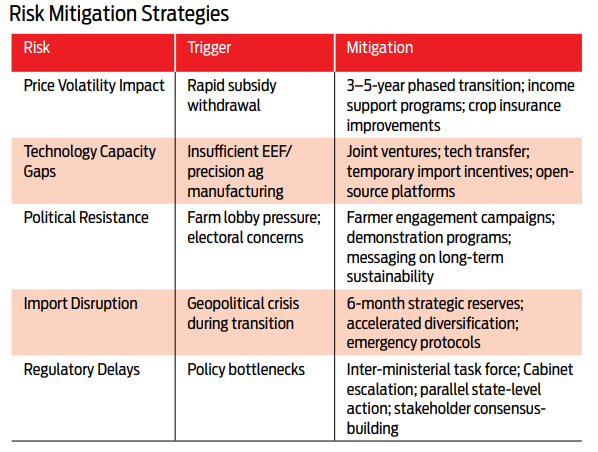
Critical Success Factors & Risks
Success Enablers
Technology Readiness: Joint ventures with international EEF manufacturers. Technology transfer agreements. Domestic manufacturing capacity expansion through incentives. Affordable precision agriculture platforms.
Farmer Buy-In: Transparent communication on subsidy reform rationale. Demonstration plots showing yield improvements. Community learning groups enabling peer knowledge sharing. Targeted income support during transition.
Political Commitment: Sustained alignment through Cabinet-level steering committee with explicit performance metrics.
Fiscal Discipline: Phased implementation (not abrupt change). Pilot-before-scale approach. Complementary income support programs. Budget allocation with mid-course adjustments.
Supply Resilience: Maintain 6-month strategic reserves throughout transition. Multi-source, multi-modal corridors. Real-time supply chain monitoring. Contingency planning for disruption scenarios.
Conclusion & Urgent Action Imperative
India's fertilizer sector faces converging crises: geopolitical vulnerability through 60%+ import concentration, fiscal unsustainability of Rs.1.86 lakh crore annual subsidies, efficiency stagnation despite rising inputs, and accelerating soil degradation threatening long-term productivity. The 8R-based transformation framework is not aspirational but techno-economically essential, fiscally imperative, strategically critical, and environmentally necessary.
The implementation window is 2025-2027. Delays of 12-18 months will compound fiscal risks during the next inevitable supply disruption, miss critical technology adoption cycles, accelerate irreversible soil degradation, and forfeit competitive advantage in sustainable agriculture.
Priority Actions (Next 180 Days):
Cabinet approval of 8R framework; authorize budget for Phase I
Complete nutrient-based incentive design; launch 100-district pilot
Issue EEF mandate regulatory directive (25% of urea)
Submit glauconite classification amendment to inter-ministerial committee
Operationalize 3-month strategic reserve infrastructure
Execute supply diversification on EEFs (5+ new JVs)
Establish Fertilizer Innovation Centre board and operational plan
Launch nationwide farmer communication campaign
Transformation is feasible. The required investments are dwarfed by fiscal benefits of subsidy reduction and strategic benefits of import independence. Technologies are proven, but need policy support.
The path to agricultural resilience, fiscal sustainability, and global leadership in sustainable nutrient management is clear. Implementation must begin immediately.
RNI No: DELBIL/2024/86754 Email: [email protected]