

BEYOND THE BAG: How Biologicals Can Reduce India’s Dependency on Chemical Fertilizers
BEYOND THE BAG: How Biologicals Can Reduce India’s Dependency on Chemical Fertilizers

Dr. Renuka Diwan
India’s agriculture is locked in an escalating dependency on synthetic fertilizers — a dependency that is economically costly, ecologically damaging, and agronomically self-defeating. Despite consuming over 60 million metric tonnes of fertilizers annually, nutrient use efficiency (NUE) in Indian soils remains among the lowest globally: 30–40% for nitrogen, 15–25% for phosphorus, and 40–50% for potassium. The remainder is lost to volatilization, leaching, runoff, and fixation. This article presents a comprehensive scientific framework for how biological interventions — specifically biofertilizers and biostimulants — can address the three fundamental bottlenecks of fertilizer performance: availability, uptake, and use efficiency. We argue that while chemical innovations (slow-release formulations, coated urea) address availability, only biologicals can resolve the plant-intrinsic limitations of uptake and metabolic use. The evidence points toward an integrated solution: soil health restoration, stress management, targeted biofertilization, and pathway-specific NUE-enhancing biostimulants working in concert.
The Scale of India’s Fertilizer Dependency
India is the world’s second-largest consumer of chemical fertilizers, accounting for approximately 17–18% of global fertilizer consumption despite cultivating roughly 11% of the world’s arable land. The trajectory has been relentlessly upward: from just 0.07 million tonnes of nutrients in 1950–51 to over 28 million tonnes of NPK nutrients in 2022–23. This 400-fold increase has powered the Green Revolution and kept food security roughly in step with population growth — but at an enormous cost.
Fertilizer subsidies now represent one of India’s largest fiscal expenditures, routinely exceeding Rs.1.5–2.0 lakh crore (approximately USD 18–24 billion) annually. Yet, the productivity returns on additional fertilizer inputs have shown marked diminishing returns since the 1990s, a classic symptom of agronomic saturation compounded by declining soil organic carbon and structural soil health degradation.
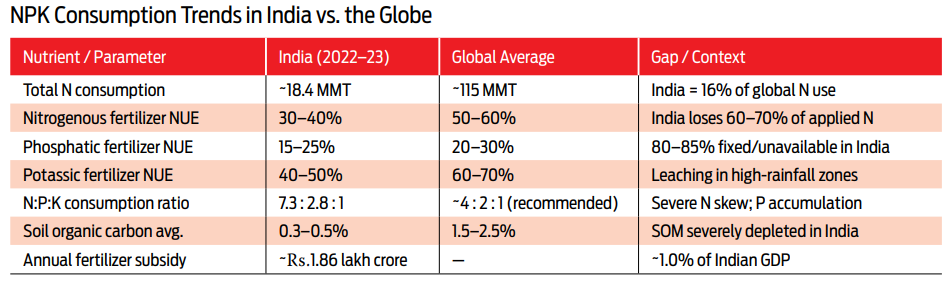
The N:P:K imbalance is particularly diagnostic: India’s nitrogen-heavy consumption pattern (driven by heavily subsidised urea) has created soils that are phosphorus-saturated in the top layer (reducing P availability through fixation) and increasingly potassium-deficient in intensive cultivation zones. The recommended ratio of 4:2:1 (N:P:K) is seldom achieved in practice — the actual ratio in 2022–23 was approximately 7.3:2.8:1.
India’s NUE for nitrogen is particularly alarming: on average, only 30–40% of applied nitrogen is taken up by crops. The remaining 60–70% is lost through volatilization (primarily ammonia and nitrous oxide emissions), denitrification, leaching into groundwater, and surface runoff into water bodies. This represents not merely an economic waste of approximately Rs.60,000–80,000 crore annually in lost nitrogen alone — but also a significant contributor to greenhouse gas emissions, groundwater nitrate contamination, and eutrophication of rivers and reservoirs.
The Declining Productivity Response
Partial factor productivity (PFP) of nitrogen — the kilograms of grain produced per kilogram of nitrogen applied — has declined from approximately 50–60 kg grain/kg N in the 1970s to under 25 kg grain/kg N in major cereal-producing states by 2020. This means that Indian farmers are applying more fertilizer for diminishing incremental yield, while simultaneously degrading the soil ecosystem that underpins long-term productivity. The systemic nature of this failure demands systemic solutions.
The Three Fundamental Bottlenecks of Fertilizer Performance
To design effective interventions, we must first understand precisely where and why fertilizers fail. There are three distinct, mechanistically separate bottlenecks that limit the conversion of applied fertilizer into crop yield. Conflating them — as is common in policy and practice — leads to misdirected interventions.
Critical insight: Chemical innovations — polymer-coated urea, urease inhibitors like N-(n-butyl) thiophosphoric triamide (NBPT), nitrification inhibitors like dicyandiamide (DCD) and 3,4-dimethylpyrazole phosphate (DMPP) — can meaningfully address Bottleneck 1 (availability). They are effective tools and form part of the solution. However, Bottlenecks 2 and 3 are intrinsic to the plant. They are governed by plant physiology, root biology, membrane transport, and enzyme kinetics. No chemical fertilizer formulation can alter how a plant root transports nitrate ions, or how efficiently a leaf cell converts glutamine into protein. This is the exclusive domain of biologicals.
Biofertilizers: Solving Availability — Biologically
Biofertilizers are preparations of living microorganisms — bacteria, fungi, cyanobacteria — that, when applied to seeds, soil, or plant surfaces, colonise the rhizosphere or root interior and promote plant growth by increasing the supply of primary nutrients. Unlike chemical fertilizers, they do not add nutrients directly but activate biogeochemical pathways that mobilise nutrients already present in soil or capture them from the environment.
Biological Nitrogen Fixation (BNF)
Biological nitrogen fixation — the enzymatic reduction of atmospheric dinitrogen (N₂) to ammonium by nitrogen-fixing organisms via the nitrogenase enzyme complex — is one of the most important nutrient acquisition processes in agriculture. BNF organisms broadly fall into two categories:
• Symbiotic fixers: Rhizobium, Bradyrhizobium, Mesorhizobium spp. forming root nodules in legumes. Well-established yields of 50–300 kg N/ha/season in legume systems.
• Free-living / associative fixers: Azotobacter, Azospirillum, Herbaspirillum, Gluconacetobacter diazotrophicus colonizing cereals and sugarcane. Contribution ranges from 5–40 kg N/ha under optimal conditions.
• Cyanobacteria: Anabaena, Nostoc spp. — particularly relevant in flooded rice (paddy) systems, contributing 20–30 kg N/ha/season historically.
In Indian cereal systems (wheat, rice, maize), Azospirillum brasilense and Azotobacter chroococcum inoculation has demonstrated 15–25% reduction in recommended N dose in field trials across ICAR research stations, without significant yield penalty. Meta-analyses of BNF contributions in Indian wheat suggest that well-established inoculants can supply the equivalent of 20–40 kg urea-N/ha under favourable soil conditions.
Phosphate Solubilising Bacteria and Fungi (PSB/PSF)
Indian soils are paradoxically phosphorus-rich in total P but phosphorus-poor in plant-available P. Decades of superphosphate and DAP application have created substantial fixed P reserves (often >1,000 kg P₂O₅/ha in top 15 cm) that are locked in insoluble complexes — calcium phosphates in alkaline soils, iron and aluminium phosphates in acidic soils.
Phosphate solubilising bacteria (Bacillus megaterium, Pseudomonas fluorescens, Burkholderia cepacia) and fungi (Aspergillus niger, Penicillium bilaiae) solubilise these fixed phosphates through production of organic acids (gluconic, oxalic, citric, malic acids) that acidify the rhizosphere and dissolve mineral-bound phosphate
Field data from the Indian Council of Agricultural Research (ICAR) network and independent studies suggest PSB inoculation can improve phosphorus use efficiency by 20–40%, effectively saving 25–50% of the recommended P dose while maintaining comparable yields. This is economically significant given that DAP prices have risen sharply post-2021.
Potassium Mobilising Bacteria (KMB) and Zinc Solubilisers
While BNF and PSB have received most research attention, potassium-mobilising bacteria (Bacillus mucilaginosus, Frateuria aurantia, Paenibacillus glucanolyticus) and zinc solubilisers (Bacillus subtilis, Thiobacillus thiooxidans) are increasingly recognised as important components. Indian soils in alluvial belts often have high structural K in mica and feldspar minerals, biologically inaccessible without microbial intervention. KMB can release 10–25 kg K/ha from these mineral reserves through organic acid-mediated weathering.
Mycorrhizal Fungi: The Hidden Nutrient Network
Arbuscular mycorrhizal fungi (AMF — Rhizophagus irregularis, Glomus mosseae, Funneliformis species) deserve special emphasis. AMF hyphal networks extend the effective root absorptive surface area by 100–800 times, accessing soil volumes and nutrient pockets entirely inaccessible to root hairs alone. In field trials across dryland India (CRIDA, Hyderabad), AMF inoculation in sorghum and groundnut improved NUE by 18–28% while reducing recommended P application by 30–50%
The Soil Health Imperative: Why Carbon is the Master Variable for N
The single most under-appreciated variable in Indian fertilizer economics is soil organic carbon (SOC). India’s average SOC stands at a critically low 0.3–0.5%, against a globally recognised threshold of 1.5% for functional soil health. This matters enormously for nitrogen because SOC is not merely a fertility indicator — it is the fundamental driver of biological nitrogen cycling, soil structure, water retention, and microbial ecosystem function.
SOC and the Nitrogen Cycle: A Mechanistic Link
When SOC drops below 0.5% — as it has in large swathes of the Indo-Gangetic Plain, particularly under continuous rice-wheat cultivation — the soil becomes effectively a passive substrate rather than an active biological system. Fertilizers applied to such soils face maximum loss rates because the biological retention mechanisms are absent. Restoring even 0.5–1.0% SOC has been shown to reduce fertilizer requirements by 15–30% while improving crop performance, according to long-term fertility trials at IARI and CRIDA.
Biostimulants: The Only Lever for Uptake and Use Efficiency
The FCO’s Plant Biostimulants Regulation defines biostimulants as products that stimulate plant nutrition processes independently of the product’s nutrient content, with the sole aim of improving one or more of: nutrient use efficiency, tolerance to abiotic stress, quality traits, or availability of confined nutrients in the soil or rhizosphere. This definition captures precisely what conventional fertilizers and even biofertilizers cannot achieve: altering the plant’s intrinsic physiological capacity to take up and utilise nutrients.
Why Stress is the Hidden Killer of Fertilizer Efficiency
This is perhaps the least discussed but most consequential mechanism driving low NUE in Indian agriculture: abiotic stress. Indian crops face chronic and acute stress from heat, drought, salinity, waterlogging, and nutrient toxicity/deficiency — often simultaneously. Under abiotic stress:
• Root growth is suppressed (reduced root length density, root hair density, and lateral root branching)
• Membrane integrity of root cells is compromised, impairing transporter function
• H⁺-ATPase activity — which drives the proton motive force necessary for secondary active nutrient transport — is reduced
The net result: even when nutrients are present in the soil solution in adequate concentrations, a stressed plant is physiologically incapable of absorbing them at full capacity. Studies have demonstrated that heat stress alone (a common reality in Indian summer crops) can reduce nitrogen uptake efficiency by 25–40% even when NUE-limiting soil factors are controlled. This is a plant physiological problem, not a soil chemistry problem — and it requires plant physiological solutions.
Targeted Biostimulants: Directly Engineering NUE Pathways
The frontier of biostimulant science has moved beyond broad-spectrum stress mitigation toward precisely targeted interventions in specific nitrogen acquisition and assimilation pathways. This represents the most scientifically sophisticated — and potentially highest-impact — approach to NUE improvement.
The GS/GOGAT Pathway: Central to Nitrogen Assimilation
The glutamine synthetase / glutamate synthase (GS/GOGAT) pathway is the primary route by which inorganic ammonium — whether from soil, BNF, or fertilizer — is incorporated into organic nitrogen compounds in plant cells. The pathway operates as follows:
NH₄⁺ + Glutamate + ATP → Glutamine (GS; Glutamine Synthetase)
Glutamine + 2-Oxoglutarate + NADH → 2 Glutamate (GOGAT; Glutamate Synthase)
Overexpression studies of GS1 in transgenic wheat and rice have demonstrated 15–30% improvements in NUE and 5–15% yield increases under N-limiting conditions. While genetic engineering faces regulatory hurdles, biostimulants that pharmacologically achieve partial GS upregulation represent a commercially and regulatorily viable pathway to similar gains.
The Arginine Pathway: Long-Distance N Transport and Storage
Arginine is the primary long-distance nitrogen transport compound in many plant species The arginine biosynthesis pathway serves as a critical N storage and remobilisation mechanism during grain fill. The agronomic implication is significant: improving arginine pathway efficiency allows more of the nitrogen already present in the vegetative plant to be translocated and utilised in grain — improving harvest index for N without requiring additional fertilizer.
Nitrogen Transporters: The Gatekeepers of Uptake
Plant roots absorb nitrogen through a family of membrane-localised transport proteins. Understanding and manipulating these transporters is key to improving Bottleneck 2:
• NRT2 Family: High-Affinity Nitrate Transporters (NRT2.1, NRT2.2; NRT1 family)
• Primary uptake systems under low nitrate conditions (< 1 mM in soil solution)
• Regulated by nitrate availability, light, carbon/nitrogen ratio
• NRT1.1: Low-Affinity Nitrate Transporters (NRT1.1/NPF6.3)
• Operates at high soil nitrate concentrations; also functions as a nitrate sensor/signal transducer
• AMT1 Family: Ammonium Transporters (AMT1;1, AMT1;2, AMT1;3)
• Critical in paddy soils where ammonium dominates the mineral nitrogen pool
• AMT expression is suppressed under nitrogen sufficiency — biostimulants that modulate the C:N sensing mechanism can maintain higher AMT expression
KEY MECHANISM: How Biostimulants Improve Transporter Function
Biostimulants improve nitrogen transporter function through four convergent mechanisms: (1) Upregulation of transporter gene expression via modulation of C:N ratio sensing and NIN-like protein (NLP) transcription factors; (2) Maintenance of plasma membrane H⁺-ATPase activity that generates the proton gradient driving secondary active transport — a process severely compromised under abiotic stress; (3) Protection of transporter proteins from ROS-mediated oxidative damage; and (4) Enhancement of root architecture (more transporter-expressing cells per unit soil volume). These mechanisms are distinct from — and complementary to — the mechanisms by which biofertilizers supply nitrogen.
The Evidence Base: How Much NUE Can Biologicals Actually Improve?
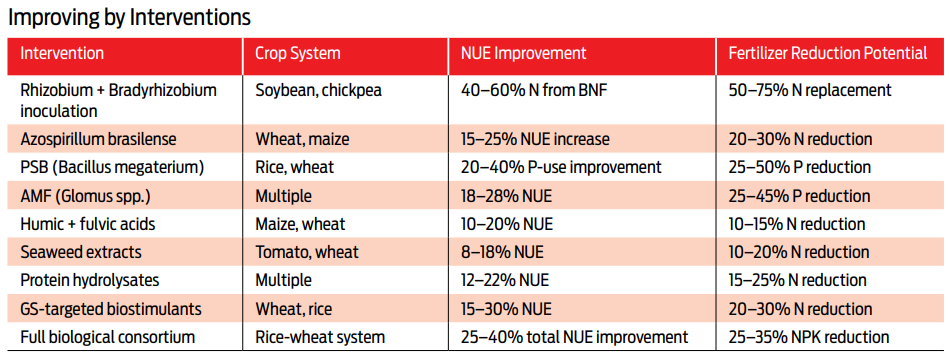
Establishing realistic quantitative claims is essential — the biologicals sector has suffered from both underselling in conservative academic circles and overselling in marketing contexts. The following represents a synthesis of peer-reviewed literature, ICAR trials, and multi-location meta-analyses:
A critical nuance: these figures represent optimised experimental or well-managed research conditions. On-farm realisation of these benefits requires product quality assurance (viable cell counts, shelf life integrity), correct application timing, adequate soil moisture, and baseline soil conditions that support microbial establishment. The gap between experiment and farm-scale realisation remains one of the central challenges for the sector.
No Silver Bullet: The Case for Integrated Biological Management
The evidence reviewed above makes one conclusion unavoidable: there is no single biological product, no single mechanism, no single intervention that alone can solve India’s fertilizer efficiency crisis. The biological optimists who claim a biofertilizer will halve fertilizer use, and the chemical purists who dismiss biologicals as ineffective in “real-world” conditions, are both wrong — in different ways.
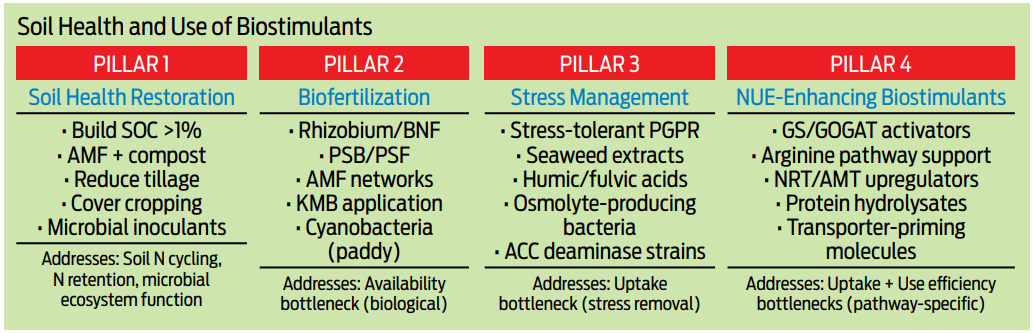
What the science consistently demonstrates is that the interventions are complementary, not competitive. Each addresses a different biological constraint. Their combined effect, when properly integrated, is substantially greater than the sum of parts. We propose the following framework — the Four Pillars of Biological NUE Enhancement: (see above)
The Integration Logic
The four pillars interact synergistically, not additively. Soil health restoration (Pillar 1) creates the environment in which biofertilizers (Pillar 2) can survive and function — a biofertilizer applied to severely degraded, low-SOC soil with disrupted microbial communities may fail to establish or persist. Stress management biostimulants (Pillar 3) ensure that even when soil supply is adequate, the plant can physiologically access it — without this, NUE-enhancing pathway biostimulants (Pillar 4) have a diminished substrate to work on. And without Pillar 4, nitrogen successfully absorbed may be assimilated inefficiently, reducing conversion to protein and yield.
Conclusion: The Path Forward
India’s fertilizer problem is not fundamentally a supply problem — it is an efficiency problem. We have enough nutrients going into our soils; we lose most of them before they reach their destination. The solution is not more fertilizer, but smarter management of the fertilizer already applied — and the nutrients already present in our soils.
Field data from the Indian Council of Agricultural Research (ICAR) network and independent studies suggest PSB inoculation can improve phosphorus use efficiency by 20–40%, effectively saving 25–50% of the recommended P dose while maintaining comparable yields.
The framework presented here offers a scientifically grounded, economically viable, and agronomically coherent path toward meaningful reduction in chemical fertilizer dependency. Chemical innovations in fertilizer formulation (controlled-release, inhibitors) address availability and deserve continued deployment. But the structural, systemic improvements in NUE — those that can move India’s nitrogen uptake efficiency from 35% toward 55–60% — can only come from biological interventions that work with plant physiology, not around it.
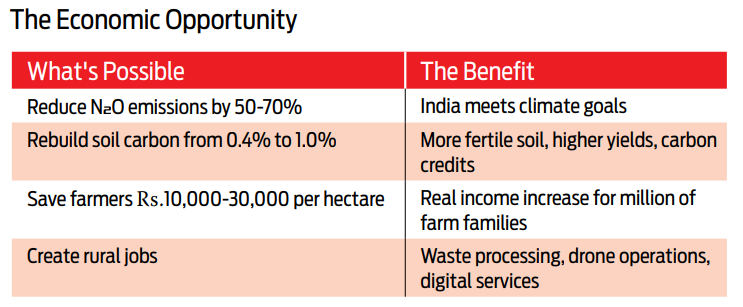
The policy implications are significant: biofertilizer and biostimulant research, quality regulation, farmer training, and economic incentivisation deserve fiscal support at a scale commensurate with their potential to reduce the chemical fertilizer subsidy burden. A rupee invested in a well-designed biological NUE program today is likely to save five to ten rupees in fertilizer subsidy over a decade.
The science is ready. The products are increasingly available. The urgency of soil health degradation, groundwater contamination, and fiscal unsustainability of the subsidy regime is evident. What remains is the integration of this knowledge into coherent policy, extension support, and farmer practice at scale. The biological revolution in Indian agriculture is not a distant aspiration — it is an agronomic and economic necessity.
RNI No: DELBIL/2024/86754 Email: [email protected]