
Farmer Income Trails Growth in Agricultural Output
GVA Data Shows Agriculture Slipping Into Deflation as Other Sectors Surge

Harvir Singh

Thanks to a better monsoon and the hard work of farmers, agriculture and allied sectors achieved a growth rate of 3.5 percent in the second quarter of the current f inancial year (2025-26), but income growth lagged behind. This has occurred for two consecutive quarters in which the value of agricultural and allied sector production did not increase in proportion to output growth. Other sectors of the economy, such as manufacturing, real estate, and f inancial services, experienced higher GVA growth rates than GDP in both the first and second quarters.
The GDP and GVA data released by the Central Statistics Office (CSO) on November 28th clarify this picture. T hey also clearly show that the terms of trade are unfavorable for agriculture and allied sectors. Overall GDP is projected to grow at 8.2 percent and GVA at 8.1 percent in the 2nd quarter.
This year saw a better monsoon. Although excessive rainfall and flooding damaged crops in many areas, better rainfall led to increased crop acreage and production during the Kharif season. Consequently, GDP growth for agriculture and allied sectors rose by 3.5 percent, although this was slightly lower than the 3.7 percent in the first quarter.
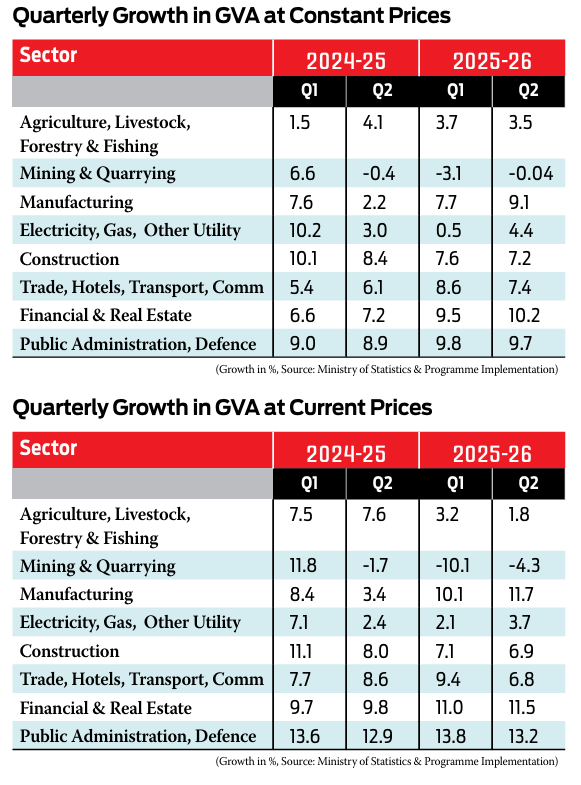
But the story is different. The first and second quarters of the current year have both seen lower growth rates of GVA in agriculture and allied sectors at current prices compared to constant prices (2011-12). GVA for agriculture and allied sectors at constant prices grew by 3.7 percent and 3.5 percent, respectively, in the first two quarters. However, GVA at current prices in the first quarter was 3.2 percent, and in the second quarter, it fell to only 1.8 percent. This means that farmers' income has not increased in proportion to their production. It also means that due to falling prices, the agricultural sector has been in a deflationary state for two quarters.
If we look at other sectors of the economy, the situation is the opposite. T he manufacturing sector grew at 7.7 percent at constant prices in the first quarter, while its growth rate at current prices in the same quarter was 10.10 percent. Similarly, GVA at constant prices in the second quarter was 9.1 percent, while at current prices it was 11.7 percent. In the tertiary sector, the GVA growth rate at current prices was higher than at constant prices in both quarters. For real estate and financial services, the figures were 9.5 percent and 11 percent in the first quarter, and 10.2 percent and 11.5 percent in the second quarter.
These figures largely illuminate the weak position of the agricultural sector. Agriculture and allied sectors contribute 14 percent to GDP, a share comparable to manufacturing. The service sector contributes the most to economic growth. According to the Periodic Labour Force Survey, 46 percent of the country's working population depends on agriculture. T herefore, low income growth in this sector is not a sign of a strong economy. However, some of the country's leading economists believe that in the next few years, more than half of the income of agriculture-dependent households will come from non-agricultural activities. According to a NABARD survey, this share is steadily increasing.
Despite the 3.5 percent growth rate of agriculture and allied sectors in the second quarter, the situation on the crop production front is not much better. This is reflected in the f irst advance estimates of Kharif season production, released a day before the GDP figures. Union Agriculture and Farmers Welfare Minister Shivraj Singh Chouhan also said in a statement that crops in many areas have been affected by excessive rainfall and natural disasters. His statement could also indicate that these figures may be revised downward in the second preliminary estimate.
According to the first advance estimates, rice production in the Kharif season (2025-26) is projected to increase from 1227.72 lakh tonnes last year to 1245.04 lakh tonnes. Maize production has also seen a significant increase, with this year's Kharif production estimated to rise from 248 lakh tonnes last year to 283.03 lakh tonnes. However, other crops, except these two, have either declined or shown only marginal increases. For example, pulse production has declined from 77.33 lakh tonnes last year to 74.13 lakh tonnes. Similarly, oilseed production has fallen from 280.23 lakh tonnes to 275.63 lakh tonnes this year. Production of soybean, the second major Kharif oilseed crop, has fallen by nearly 10 lakh tonnes and is estimated at 142.66 lakh tonnes, down from last year's 152.68 lakh tonnes. Significantly, we are dependent on imports for edible oils and pulses, while domestic production is declining and farmers are not even receiving the minimum support price (MSP).
Production of cotton, the main commercial Kharif crop, is estimated to decline from last year's 297.24 lakh bales to 292.15 lakh bales. Reports have emerged from most cotton-producing regions of the country that cotton farmers are selling their produce at prices approximately Rs 1,000 per quintal below the MSP. The government has allowed duty-free imports of cotton until December 2025.
These figures confirm a moderate increase in agricultural GDP, but the overall situation is not encouraging. T he decline in crop prices is directly affecting GVA. The government and the Reserve Bank are succeeding in controlling inflation as food prices continue to fall, but the GVA figures clearly show the direct impact this is having on farmers' incomes. These f igures also indicate a difficult period for the agricultural sector, as in the current Kharif marketing season, farmers are not even receiving MSP for most crops. This means the agricultural sector is facing a structural crisis, which will directly affect the rural economy.
RNI No: DELBIL/2024/86754 Email: [email protected]