

A Turning Point for India’s Sugarcane Policy
At the national consultation on the sugarcane sector, the government announced a dedicated ICAR team to address urgent needs in research and policy, while experts and industry leaders mapped a five-year vision

Ajeet Singh

India’s sugarcane sector stands at a crossroads, faced with longstanding challenges but also unique opportunities. At the forefront of change, Union Agriculture Minister Shivraj Singh Chouhan declared a new, targeted research initiative within the Indian Council of Agricultural Research (ICAR), focused specifically on sugarcane. This announcement, made during a high-profile national consultation organised by Rural Voice, ICAR and the National Federation of Cooperative Sugar Factories (NFCSF), underscores a shift in policy towards practical, problem-solving research for the benefit of farmers and the industry.
Chouhan emphasised that the sector’s issues are multi-layered: popular sugarcane variety 0238 has boosted sugar content but is dangerously vulnerable to red rot disease and encourages monocropping, which in turn increases risks from pests and soil depletion. He advocated parallel efforts to breed alternatives and control emerging threats, with a focus on production, mechanisation, sugar recovery, cost reduction, and judicious water use. The Minister acknowledged genuine farmer grievances, especially around delayed payments, and called for reforms to make sugarcane a catalyst for India’s agricultural future.
ICAR Director General Dr. M.L. Jat further distilled the national agenda into four key research foci: pinpointing priorities, addressing developmental and industry-linked issues, and crafting actionable policies. His diagnosis highlighted unsustainable water and fertilizer usage, vulnerability to monocropping, and a pressing need for cropping system diversification.
Voices from the Fields: Farmer Realities
The discussions at the national consultation gave pride of place to farmers’ voices, surfacing their immediate concerns and practical suggestions. Across states, progressive growers expressed frustrations over disease-prone varieties and insufficient alternatives since CO-0238, persistent labor shortages, and the growing f inancial pressures from stagnant cane prices and rising input costs.
Farmers urged the government and research bodies to focus on developing high-yield, disease-resistant varieties, ensure quicker release and distribution of seeds, and offer mechanisation support tailored for smallholder plots. They criticised inefficiencies in subsidy usage, the lack of targeted grants, and the persistent gap between research claims and ground performance. They highlighted the trench method and intercropping - especially peanut intercropping - as boosting yields and resisting diseases.
Umesh Kumar from Uttar Pradesh typified farmer anxieties: rising inflation has made sugarcane cultivation less viable, acreage has declined, and farm incomes now often lag behind rural employment schemes. Mechanisation, particularly small harvesters, emerged as a universal need.
Industry Perspectives: The Value Chain Under Stress
Alongside farmers, industry leaders spotlighted broader structural and technological challenges. Deepak Ballani of the ISMA stressed the urgency of fast-tracking the release of new varieties, utilising tissue culture, and leveraging artificial intelligence (AI) to increase sugar and ethanol yields. He argued for establishing a National Sugarcane Development Board to lead innovation, reduce bureaucracy, and directly link policy to ground realities.
Roshan Lal Tamak, CEO and ED (Sugar Division) of DCM Shriram Limited, pointed out the persistent discrepancies between scientific projections and field outcomes. He advocated more participatory research, faster variety release, and small harvester development, especially for the patchwork of small farms that dominate Indian agriculture. He also called for climate adaptation, urging tissue culture and seed technology projects to keep pace with changing field conditions.
Atul Chaturvedi, Executive Chairman, Renuka Sugars Limited, laid out the economic picture: declining operating days at sugar mills, lagging ethanol prices despite higher cane prices, and the need for policies that actually support both farmers and processors. He highlighted distortion in ethanol procurement, with grain ethanol fetching higher rates than cane ethanol, and called for a recalibration of national priorities: ethanol prices must be raised, and policies should align incentives across the value chain.
Research and Technology: Pathways to Sustainability
Throughout the consultation, experts dissected the technical and scientific underpinnings of current sugarcane practices and mapped out innovative solutions. Dr. Devendra Kumar Yadava, Deputy Director General (Crop Science) at ICAR, addressed the monocropping risks posed by popular varieties like CO 0238. He explained both the advantages and the trade-offs, stressing the slow pace of new variety development. Diversification emerged as a cornerstone strategy: pulses and oilseeds can be intercropped with sugarcane, sharing water and fertilizer while boosting system resilience and farmer incomes. Intercropping peanuts, as practiced in Uttar Pradesh, increased cane yields by 10–12%, and nitrogen fixing legumes improved soil fertility. Resource efficiency was another major concern: current practices demand vast amounts of water and fertilizer, both increasingly scarce. Micro irrigation and AI-driven soil moisture mapping, as trialed in Maharashtra, can reduce water needs dramatically. AI-powered platforms, using satellite imagery and sensor analytics, are already helping farmers predict disease outbreaks, reduce input costs, and increase yields. These innovations can raise yields by up to 40%, cut labor by as much as 40%, and halve water usage.
Despite the availability of advanced machinery, overall mechanisation in sugarcane - especially harvesting - remains low, largely due to the small plot sizes that define Indian agriculture. Dr. C.R. Mehta of ICAR’s Central Institute of Agricultural Engineering underscored the need for appropriately scaled machines, adaptable to local conditions, and cost effective for smallholders. Only with widespread adoption can mechanization truly transform the sector.
Policy and Pricing: Bridging the Gaps
The fourth session of the consultation zeroed in on policy, pricing, and payment structures. NFCSF Managing Director Prakash Naiknavare provided a window into the complex, multi-layered process for setting sugarcane prices - a chain that starts with the Ministry of Agriculture, winds through a committee of secretaries and inter-ministerial groups, before f inally reaching the group of ministers.
This process is currently headed by Cooperative Minister Amit Shah and includes ministers of agriculture, commerce, food, finance, and, recently, road transport. Representatives from both the National Sugar Federation and ISMA are consulted before any pricing note is drafted. Nevertheless, payment arrears remain stubbornly high, at approximately Rs 6,500 crore this year.
Pricing pressures are amplified by the ethanol conundrum. Ethanol prices have remained static for three years, even as sugarcane prices rise, and oil companies pay more for grain-based ethanol than for cane ethanol. This threatens the viability of sugarcane-based ethanol, undermining both farmer income and mill profitability.
Dr. U.S. Tewatia, Chief Agriculture Scientist, Indian Potash Limited urged policymakers to ground their decisions in field-level realities, echoing the refrain that development must be farmer-oriented and practical. Innovations, whether in machinery or new varieties, must prove themselves in actual farm settings, not just research journals. Only then will the sector see meaningful progress.
Coordination and the Road Ahead
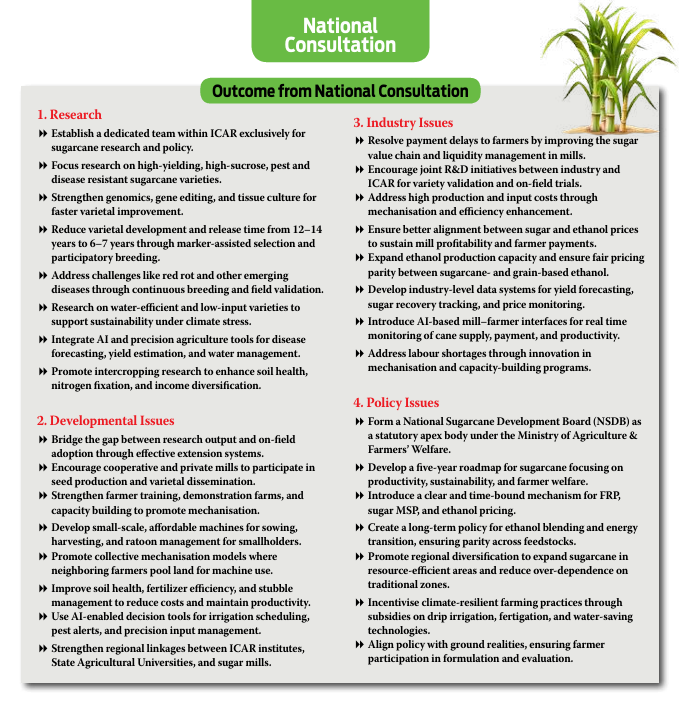
Moderating the event, Harvir Singh, Editor-in-Chief of Rural Voice, called for strengthened dialogue and collaborative action across stakeholder groups. The consultation’s outcomes - richer, farmer-driven research, broader institutional support, and smarter technology adoption - promise to lay the foundation for a reinvigorated sugarcane sector. The roadmap sets the stage for holistic transformation: from improved variety release and tailored mechanisation, to sustainable cropping and innovative market strategies.
If implemented, these interventions will address farmer grievances, modernise the value chain, and align policy with on-the-ground needs, driving both economic growth and rural welfare. T he spirit of the New Delhi consultation underscores a new ethos: research must serve the farmer, and policy must be dynamic and inclusive. India’s sugarcane futures - economic, environmental, and social - depend on it.
RNI No: DELBIL/2024/86754 Email: [email protected]