

Rural Incomes Weaken, Informal Credit Gains Ground
The latest NABARD survey points to emerging stress in the rural economy, with rural income growth slowing to a two-year low while rural households' reliance on informal credit is increasing

Ajeet Singh
I ndia's rural economy is showing signs of losing momentum as weaker income growth, subdued savings and rising dependence on informal credit point to growing financial stress among rural households. The findings come at a time when concerns over an El Niñoled weak monsoon continue to weigh on agricultural prospects.
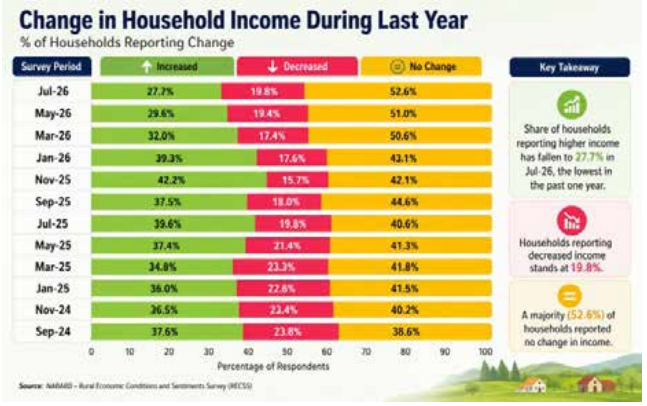
According to the National Bank for Agriculture and Rural Development (Nabard)'s Rural Economic Conditions and Sentiments Survey (July 2026), only 27.7 per cent of rural households reported an increase in income over the past year, down from 29.6 per cent in the previous survey and 42.2 per cent in November 2025. This is the lowest level since the bi-monthly survey was launched in September 2024.
Meanwhile, 52.6 per cent of households said their income remained unchanged during the past year, while 19.8 per cent reported a decline in income. In other words, nearly 72.4 per cent of rural households experienced either stagnant or declining incomes, highlighting the slowdown in rural income growth.
Nabard attributed the moderation to higher global commodity prices, concerns over El Niño conditions, below-normal rainfall in parts of the country and slower kharif sowing. However, it noted that overall rural conditions remained broadly stable due to the progress of the southwest monsoon and continued public spending.
Consumption and savings lose momentum
The slowdown in income growth is also reflected in household spending patterns. The proportion of rural households reporting an increase in consumption expenditure declined to 74.1 per cent, compared with 77.2 per cent in May 2026 and 76.6 per cent in July 2025. It is only the second time since the survey began that the figure has fallen below 75 per cent.
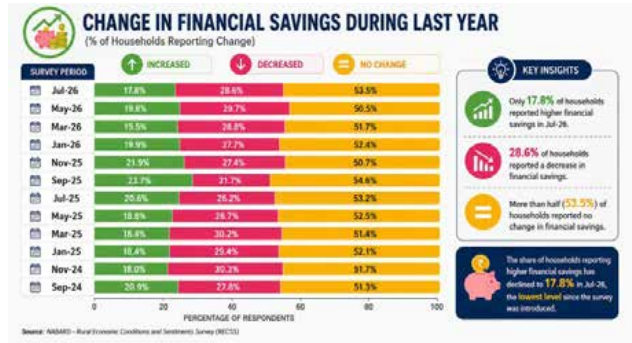
Despite this moderation, rural households continue to spend nearly two-thirds (66.5 per cent) of their monthly income on consumption, while 12.5 per cent is spent on loan repayments. The figures indicate that a significant share of household income is being absorbed by essential expenditure and debt servicing, leaving limited scope for savings.The survey also found that the share of households reporting an increase in financial savings fell to 17.8 per cent, the lowest level since the survey was introduced.
Informal borrowing gathers pace
The most significant finding of the survey is the growing dependence on informal sources of credit, where borrowers typically face much higher borrowing costs than in the formal financial system.
The share of households relying exclusively on formal sources of credit—including banks, NBFCs and cooperative institutions—declined to 51 per cent, down from a peak of 58.3 per cent recorded in November 2025.
In contrast, the proportion of households depending solely on informal sources of finance rose to 23.6 per cent, compared with 17.6 per cent in March 2025, the highest level recorded since the survey began.
Among households relying exclusively on informal finance, nearly two-thirds borrowed from friends and relatives. Of all households dependent solely on informal credit, 16.2 per cent borrowed only from friends and relatives, 6 per cent relied exclusively on moneylenders, while 1.4 per cent borrowed from both.
Another 25.3 per cent of rural households reported borrowing from both formal and informal sources.
According to the survey, loans obtained from informal sources carried an average interest rate of 17.77 per cent. Around 20 per cent of respondents, however, reported receiving interest-free loans, suggesting that these borrowings largely came from family members, relatives or friends.
The increasing reliance on informal finance suggests that rural households may be facing growing liquidity pressures or encountering barriers in accessing institutional credit.
Commenting on the trend, Abheek Barua, Chief Economist at HDFC Bank, told Rural World that convenience remains the primary reason behind the continued dependence on informal lenders.
"Reliance on informal credit is largely driven by ease of access. Financial literacy may still be a factor to some extent. Although most rural households now have access to banking services, thanks in part to financial inclusion initiatives, the formal lending process—including credit assessment and documentation— continues to appear cumbersome for many borrowers. As a result, people often find it more convenient to borrow from family members, relatives or moneylenders," he said.
Financial literacy remains weak
A separate Nabard study conducted in June 2026 found that only 23 per cent of rural households were aware of what a credit score is and how it affects access to loans, highlighting a significant financial literacy gap despite efforts to expand institutional lending.
The study also found that nearly half of rural households considered borrowing to be too expensive. Many respondents said that lower borrowing costs, including through interest subvention schemes, would improve access to formal finance.
The findings assume greater significance in the context of the Union Budget 2026-27, which announced the introduction of a Grameen Credit Score framework aimed at helping rural borrowers build formal credit histories and improve access to institutional finance.
Rural confidence weakens
The July 2026 survey also showed that rural households have become more cautious about the future.
The proportion of households expecting improvements in income and employment over the next quarter fell to the lowest level since the survey began. Likewise, the share of households expecting higher incomes over the next year declined to 66.8 per cent, another record low.
Nabard said uncertainty surrounding monsoon conditions and broader economic developments has weighed on rural sentiment. If income and employment conditions do not improve in the coming months, the slowdown could begin to affect rural consumption, investment and overall economic activity more visibly
RNI No: DELBIL/2024/86754 Email: [email protected]