

WTO Faces Relevance Test
Commerce and Industries Minister Piyush Goyal (right) at MC 14

SK Singh
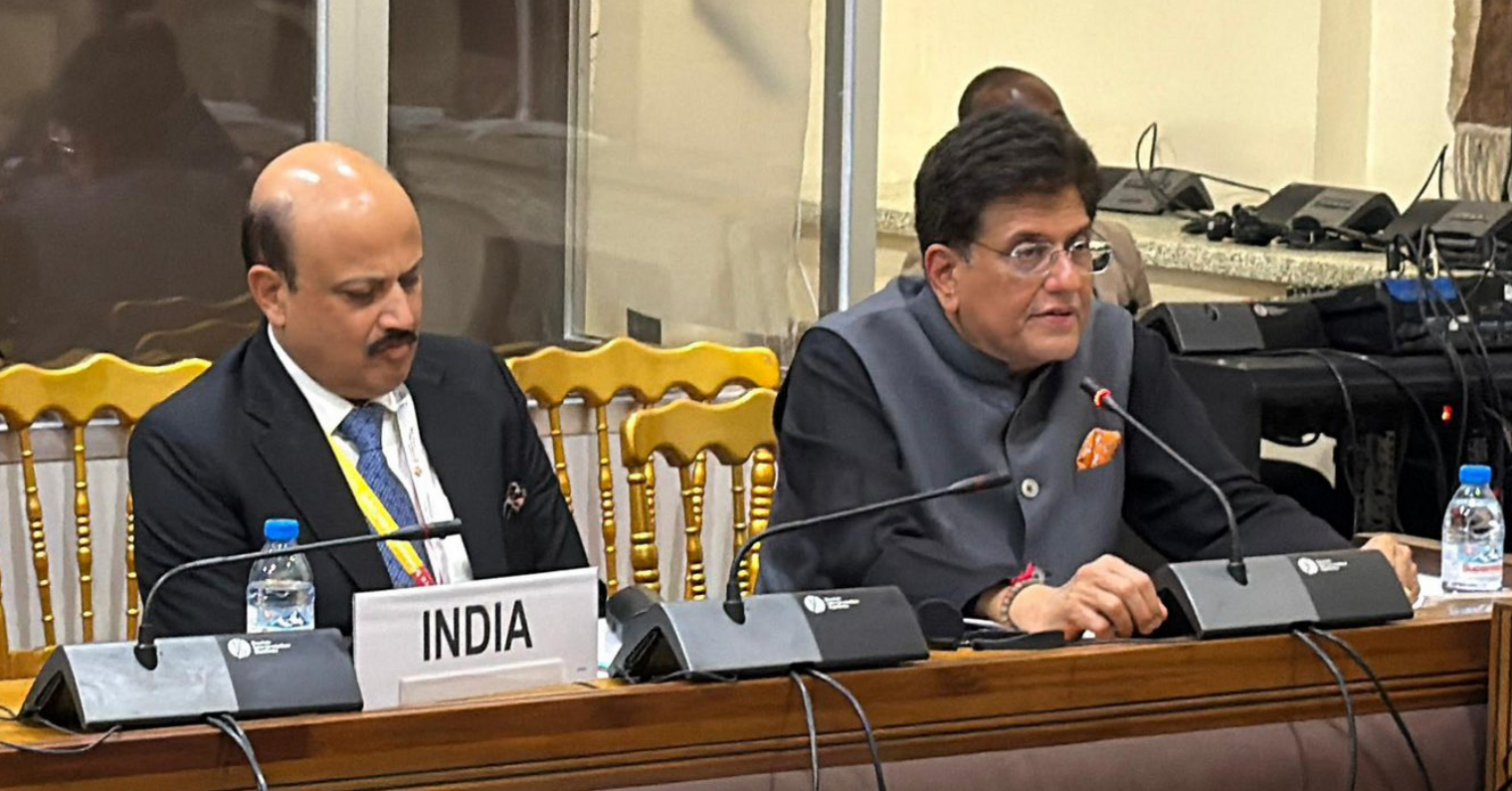
The World Trade Organization’s 14th Ministerial Conference (MC14), held in Yaoundé, Cameroon from March 26-29, ended in a stalemate, exposing deep divisions in the multilateral trading system. Key decisions on agriculture, e-commerce and institutional reform were deferred to Geneva, making MC14 one of the most inconclusive ministerials in recent years and raising serious concerns over the WTO’s ability to deliver meaningful outcomes in a rapidly changing global trade environment.
Director-General Ngozi OkonjoIweala said members had come close to agreement but ultimately fell short. Draft texts on WTO reform, electronic commerce, TRIPS nonviolation complaints and a package for Least Developed Countries (LDCs) will now be taken up at the next General Council meeting in Geneva. The inability to secure even a minimal package highlights growing strain on the WTO’s consensus-based system and weakening trust among members.
A major flashpoint was the failure to extend the moratorium on customs duties on electronic transmissions, in place since 1998. Developed economies led by the US, with support from the EU and Japan, pushed for a long-term extension, while developing countries opposed it, citing revenue losses and reduced policy space. Brazil blocked compromise proposals, including okrummy download a four-year extension, linking it to lack of progress in agriculture talks. As a result, the moratorium lapsed for the first time in 26 years, allowing countries to impose tariffs on digital trade.
The lapse also ended the safeguard against non-violation complaints under the TRIPS Agreement.
According to Ajay Srivastava of the Global Trade Research Initiative, this exposes developing countries to disputes even when policies comply with WTO rules. Measures such as compulsory licensing could now be challenged for affecting expected commercial gains.
Efforts to advance WTO reform also remained deadlocked. A proposal to work toward reforms by 2028 failed to gain consensus, reflecting divisions between advanced economies seeking faster decision-making and stricter rules, and developing countries wanting to preserve policy flexibility and consensus. The Investment Facilitation for Development Agreement (IFDA) remains blocked due to India’s opposition, which argues that such plurilateral deals weaken the WTO’s multilateral character. Meanwhile, 66 members moved ahead with a separate e-commerce agreement outside the WTO, signalling a shift toward rule-making beyond its framework.
MC14 stands out not only for failing to deliver new outcomes but also for allowing existing safeguards to lapse. Unlike MC11 (Buenos Aires, 2017) and MC5 (Cancún, 2003), MC14 reflects an inability to maintain even the status quo, with unresolved issues like agriculture derailing progress across negotiating areas.
Amid the deadlock, fisheries subsidies negotiations saw limited progress. India, led by Commerce Minister Piyush Goyal, pushed for equity through Special and Differential Treatment, Common but Differentiated Responsibilities, and the Polluter Pays Principle. India proposed a 25-year transition period, curbs on industrial fleets, protection for small fishers, and subsidy disciplines based on per capita intensity. Goyal noted fisheries support over 9 million Indian families, with subsidies of about $15 per family annually.
With safeguards eroding, reforms stalled and negotiations increasingly shifting outside its framework, MC14 leaves the WTO at a critical juncture. The outcome underscores the urgent need for rebuilding consensus, restoring credibility, and addressing long-pending issues to ensure the institution remains relevant in governing global trade.
RNI No: DELBIL/2024/86754 Email: [email protected]