

Advanced Reproductive Tech Powers Elite Sahiwal Calves at IVRI
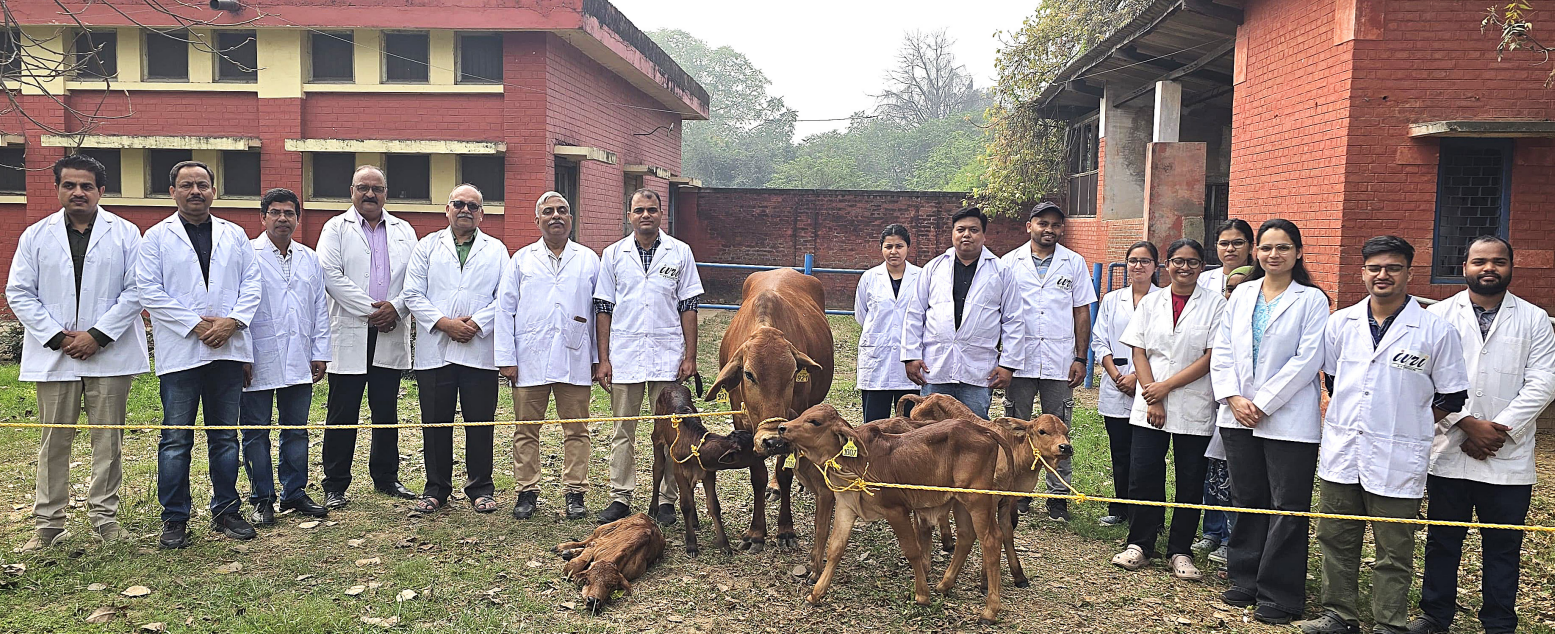
The team of scientists and research students
Dr Raghavendra Bhatta
The ICAR–Indian Veterinary Research Institute (ICAR-IVRI) has a long and distinguished legacy of developing cutting-edge technologies in animal health and production, playing a transformative role in enhancing rural prosperity and strengthening India’s dairy sector.
In a landmark scientific breakthrough, ICARIVRI has successfully produced five Sahiwal calves—four males and one female—using advanced assisted reproductive technologies, specifically ultrasound-guided transvaginal oocyte aspiration, in vitro embryo production, and embryo transfer (OPU–IVF–ET). The first calf, a female named “Gauri,” was born on 28 February 2026, followed by four healthy male calves over the subsequent four days. This represents a significant leap forward in the application of high-end reproductive biotechnologies to indigenous cattle.
These calves were produced using genetically superior germplasm, reflecting a strategic and science-driven approach to genetic improvement. The donor Sahiwal cow was an elite animal yielding more than 12 litres of milk per day, while the semen was sourced from a proven bull whose dam recorded an impressive lactation yield of approximately 3,320 kg.
ICAR-IVRI re-initiated its indigenous bovine breeding programme through embryo transfer in 2018, producing around 30 calves under both farm and field conditions using in vivo techniques, particularly Multiple Ovulation and Embryo Transfer (MOET). However, recognizing the inherent limitations of these methods— such as high hormonal costs, restricted donor utilization, and operational challenges—the institute strategically transitioned to the more versatile and efficient OPU–IVF–ET technology during 2022–23.
Demonstrating remarkable technical excellence, the IVRI team successfully standardized ultrasound-guided OPU procedures in indigenous cattle and buffalo under nonstimulated donor conditions. The outcomes have been highly encouraging, with average oocyte recovery rates of approximately 14.5 per donor in Tharparkar cattle, 13.14 in Sahiwal, and 4.5–5.5 in Murrah buffalo. Blastocyst production rates exceeded 47% in cattle and 42% in Murrah buffalo—benchmarks comparable to those achieved by leading international laboratories. The successful establishment of pregnancies further validates the robustness, efficiency, and field applicability of the technology.
The IVF–embryo transfer programme in Sahiwal cattle, initiated in 2023, encountered initial setbacks. However, sustained scientific refinement and rigorous research efforts culminated in a major breakthrough in 2025, when 16 embryos were transferred into crossbred Vrindavani cattle recipients, resulting in five confirmed pregnancies. It reflects perseverance and technical precision of the IVRI team.
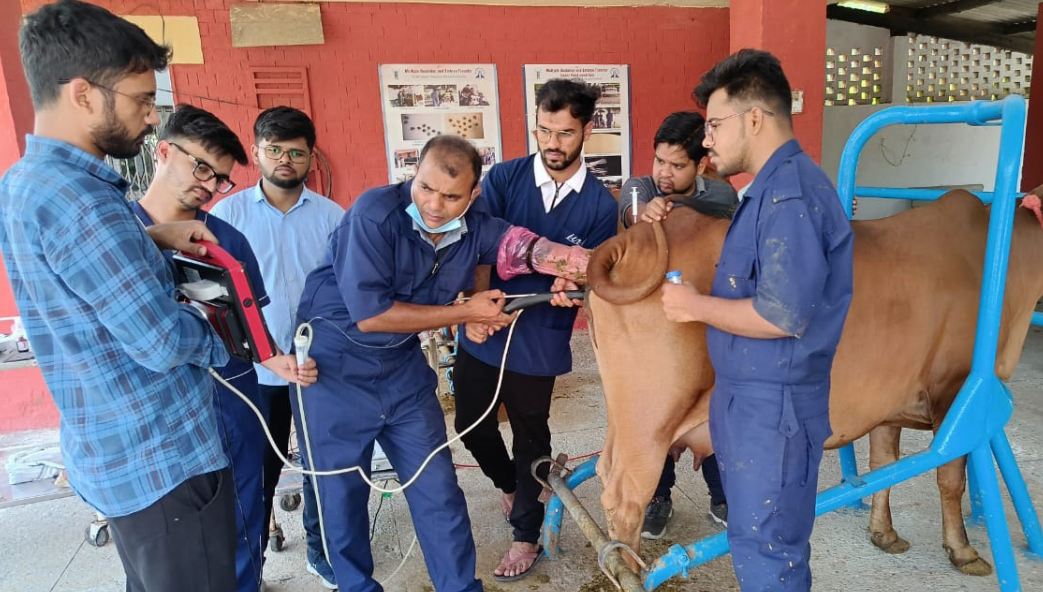
USG guided Trans-vaginal aspiration of oocytes from Sahiwal Cattle
This success is underpinned by a meticulously optimized and standardized workflow. The process begins with the careful selection of elite donor animals exhibiting high milk yield and a favorable antral follicle count (>18). Oocyte retrieval is performed through ultrasoundguided transvaginal aspiration during the early luteal or follicular phase, using controlled negative pressure (~70–75 mm Hg) to ensure optimal recovery. Retrieved oocytes are then filtered, washed, and morphologically graded before undergoing in vitro maturation under precisely regulated tri-gas incubation conditions.
Subsequently, matured oocytes are fertilized in vitro using processed semen from genetically superior bulls. The semen is prepared through a refined Percoll gradient technique to ensure high motility and fertilization efficiency. The resulting embryos are cultured under controlled conditions for approximately seven days, with close monitoring of blastocyst development and quality. This integrated and highly controlled approach has been instrumental in achieving high blastocyst yields along with successful pregnancy outcomes.
This pioneering work was carried out by a multidisciplinary team led by Dr. Brijesh Kumar (Animal Repro. Division), along with Dr. Vikrant Singh Chouhan and Dr. Vikas Chandra (Physiology and Climatology Division), and Dr. M. K. Patra (Livestock Production Management Section), supported by dedicated research scholars. The effort was guided by the visionary leadership of Dr. S. K. Singh, Joint Director (Research), with strong institutional support from Dr. Mukesh Singh (In-Charge, LPM), Dr. M. H. Khan (Head, Animal Reproduction Division), Dr. Gyanendra Singh (Physiology and Climatology Division), and Dr. Anuj Chauhan (In-charge, Cattle and Buffalo Farm).
Over the past two and a half years, the team has systematically standardized OPU–IVF protocols for indigenous cattle breeds, including Sahiwal and Tharparkar, as well as Murrah buffalo, achieving a high degree of technical consistency and reproducibility.
Beyond technological innovation, ICARIVRI continues to play a pivotal role in capacity building, with numerous trainees from its Embryo Transfer Laboratory now contributing effectively to reputed laboratories across the country.
I believe that this breakthrough will usher in a new era of innovation in assisted reproductive technologies, significantly accelerating genetic improvement programmes across the nation.
Looking ahead, ICAR-IVRI aims to scale up the production of elite indigenous cattle and buffalo under both farm and field conditions, while simultaneously developing a robust pool of skilled manpower in assisted reproductive technologies (ARTs). These efforts are expected to enhance the productivity of indigenous livestock, improve farmers’ incomes, and contribute meaningfully to sustainable rural development, thereby reshaping India’s livestock sector.
Dr. M. L. Jat, Secretary, Department of Agricultural Research and Education (DARE) and Director General, ICAR, emphasized the transformative role of advanced technologies in strengthening Indian agriculture and livestock systems. Appreciating ICARIVRI’s achievements in assisted reproductive technologies, he described the successful application of OPU–IVF–ET resulting in elite Sahiwal calves as a major milestone in genetic improvement. He further underscored that capacity building and the wider dissemination of ARTs are critical for enhancing farmers’ income and ensuring long-term sustainability. He expressed confidence that IVRI’s efforts will accelerate the nationwide adoption of advanced breeding technologies and further strengthen the livestock sector.
Over the past two and a half years, the team has systematically standardized OPU–IVF protocols for indigenous cattle breeds, including Sahiwal and Tharparkar, as well as Murrah buffalo, achieving a high degree of technical consistency and reproducibility.
RNI No: DELBIL/2024/86754 Email: [email protected]