

Re-Prioritising Agriculture

Ajeet Singh

When Finance Minister Nirmala Sitharaman presented her ninth consecutive Union Budget, she edged closer to a record set by former Prime Minister Morarji Desai. Desai’s legacy, however, is remembered not merely for the number of budgets he delivered, but for an episode before Independence— when Sardar Vallabhbhai Patel sent him to support Gujarat’s milk farmers protesting against Polson a private dairy company. At that moment, farmers were not a footnote; they were central to economic and political change. That historical contrast casts a long shadow over the Union Budget for 2026–27.
For the first time in decades, agriculture and the rural economy are conspicuously absent from the heart of the budget narrative. The word “farmer” appears barely half a dozen times. A lone, modest subheading gestures towards increasing farmers’ income. Beyond this, agriculture is largely left untouched—not as a growth engine, not as a sector in crisis, and not even as a political priority.
Two initiatives stand out: the use of artificial intelligence for plantation crops and crop advisory services, and the digital expansion of agricultural databases through integration of AgriStack and ICAR. Together, these initiatives carry a combined allocation of Rs 500 crore. Apart from these limited interventions, the budget signals a year of policy inertia for agriculture.
The Finance Minister structured the budget around three broad kartavya. Under the first—accelerating economic growth—six priority areas were identified. Agriculture was not among them. Farmers appeared only under the third task, “Sabka Saath, Sabka Vikas,” grouped alongside the most vulnerable.sections of society, including persons with disabilities.
A Shrinking Slice of a Growing Budget
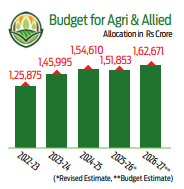
The budget for agriculture and allied sectors stands at Rs 1,62,671 crore, up marginally from Rs 1,58,838 crore last year. However, the revised estimate of expenditure for the current year is Rs 1,51,853 crore, indicating significant underspending across several schemes. As a share of total expenditure, agriculture now accounts for just 3.04%. In 2019–20, the figure stood at 5.44%.
Even more troubling is the widening gap between budgeted allocations and actual spending. Last year, ₹1.71 lakh crore was allocated for agriculture and allied sectors, but revised estimates show actual expenditure dropping to ₹1.52 lakh crore—a cut of nearly ₹20,000 crore, or about 12%. While the 2026–27 budget estimates appear higher than last year’s revised figures, they are effectively lower than last year’s original allocation. At this rate, agriculture’s share in actual government spending is likely to fall below 3%—an alarmingly low figure for a sector that supports nearly half of India’s workforce.
Research Retreats Amid Climate Stress
The Ministry of Agriculture and Farmers Welfare has received a marginal increase of just 2.1%, with its allocation rising from ₹1.37 lakh crore to ₹1.40 lakh crore. Within this, the Department of Agriculture and Farmers Welfare has seen a modest increase (from 1.27 lakh crore to 1.30 lakh crore), but agricultural research has taken a clear hit.
The budget for the Department of Agricultural Research and Education (DARE) has been cut by nearly 5%, from ₹10,466 crore to ₹9,967 crore. The Indian Council of Agricultural Research (ICAR) has seen its allocation reduced by about ₹300 crore, from ₹6,559 crore to ₹6,275 crore. Krishi Vigyan Kendras have received only a marginal increase of ₹210 crore.
These cuts come despite repeated calls for greater public investment in agricultural research—particularly at a time when climate volatility is undermining farm productivity and incomes.
Dr Shahidur Rashid, Director of the International Food Policy Research Institute (IFPRI) South Asia, has argued that sustained investment in agricultural research is essential for seed innovation and productivity growth. Strengthening this ecosystem, he says, would bolster India’s claim to leadership in agriculture across the Global South. Several experts, however, suggest that the cuts reflect government concerns over administrative capacity and the ability of research institutions to absorb higher funding.
Livestock and Fisheries Take the Spotlight
If crop agriculture has been sidelined, animal husbandry and fisheries have clearly emerged as budgetary favourites. The allocation for the Ministry of Fisheries, Animal Husbandry and Dairying has jumped from ₹7,544 crore to ₹8,915 crore in 2026–27—an increase of about 18%. A credit-linked subsidy scheme has been announced to strengthen veterinary infrastructure, with the aim of adding over 20,000 veterinary professionals nationwide. The government plans to support private investment in veterinary and para-veterinary colleges, hospitals, diagnostic labs, and breeding centres, while also encouraging partnerships with foreign institutions.
The Finance Minister underscored the importance of modernising livestock enterprises, building dairy, poultry, and livestock-focused value chains, and promoting Livestock Farmer Producer Organisations (FPOs). Entrepreneurship in animal husbandry is expected to generate employment in rural and semi-urban areas, particularly as the sector already contributes nearly 16% to agricultural income.
Fisheries, too, have received attention. The budget announced plans to develop 500 reservoirs and Amrit Sarovars, strengthen coastal fish value chains, and improve market linkages through startups, women’s groups, and Fish Farmer Producer Organisations.
Yet here as well, implementation concerns persist. For 2025-26, the Fisheries Department’s budget estimate of ₹2,703 crore was slashed to ₹1,732 crore in the revised estimates—a reduction of 36%. For 2026–27, the allocation has been raised to ₹2,761 crore, higher than last year’s revised figure but barely above the original allocation, raising fresh questions about spending capacity and execution.
The Allure and Limits of High-Value Agriculture
In Budget 2026–27, the Finance Minister returned to a familiar theme: crop diversification through high-value agriculture as a pathway to higher farm incomes. The promise is seductive—premium crops, global markets, and farmers moving up the value chain. Coconut, sandalwood, cocoa and cashew are to be promoted along coastal belts; agarwood in the Northeast; and almonds, walnuts, and pine nuts in India’s mountainous regions.
But beneath the aspirational language lies a modest commitment. The total allocation for promoting highvalue crops stands at just ₹350 crore— an amount that appears strikingly inadequate for a country as vast and agrarian as India.
A Coconut Promotion Scheme has been announced to replace ageing and unproductive trees with superior planting material. A special programme for cashew and cocoa aims to make India self-reliant in both crops, with an ambitious declaration that Indian cashew and cocoa will emerge as global brands by 2030. The Centre also plans to work with states to revive sandalwood plantations and processing, restoring the once-legendary reputation of Indian sandalwood. Similar renovation drives are proposed for old and low-yielding walnut, almond and pine plantations, alongside a push for intensive farming.
Experts acknowledge that diversification towards high-value crops makes economic sense—but only up to a point. These initiatives cater to a narrow, geographically concentrated group of farmers. Large sections of India’s agrarian population remain untouched by such schemes. Critics also note that many of these crop clusters align closely with politically sensitive states such as Tamil Nadu and Kerala, raising questions about whether electoral considerations, rather than a national agrarian strategy, are shaping policy choices.
The Silences in the Budget
Beyond high-value agriculture, the budget falls conspicuously quiet on the broader agriculture and horticulture sectors—despite the fact that millions of farmers depend on them for survival. There is no mention of the chronic distress faced by potato, onion and tomato growers, no renewed push for self-sufficiency in pulses and oilseeds, and no strategy to address the persistent crisis in cotton.
Most glaringly, the budget shows little urgency in responding to the climate crisis, which has become the defining challenge for Indian agriculture. As erratic rainfall, heatwaves and extreme weather events increasingly disrupt farm livelihoods, the absence of a coherent climateresilience roadmap is hard to ignore.
Farmers Push Back
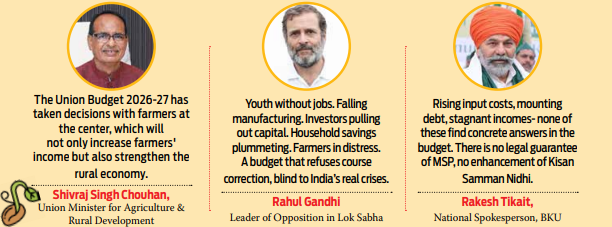
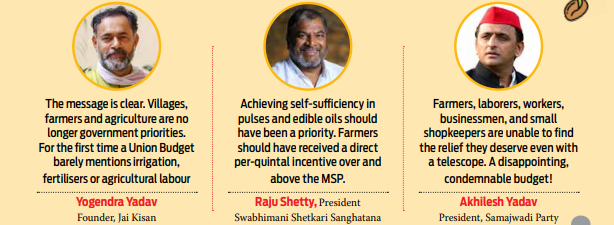
Farmer organisations have reacted with sharp disappointment. Bharatiya Kisan Union national spokesperson Rakesh Tikait says expectations from the budget were high, but largely unmet. Rising input costs, mounting debt, stagnant incomes—none of these find concrete answers in the budget. There is no legal guarantee of Minimum Support Price, no enhancement of Kisan Samman Nidhi, and no substantial increase in overall agricultural spending. Social activist and Jai Kisan movement founder Yogendra Yadav reads the budget as a political signal.
“The message is clear,” he says. “Villages, farmers and agriculture are no longer government priorities.” For the first time, he argues, a budget that doesn't even mention farmers—no irrigation, no fertilizer, no agricultural laborers. When farmers do appear, it is only as part of the generic category of the poor.
Technology as a Partial Answer: Bharat Vistar
One of the budget’s more prominent announcements is Bharat Vistar—the Virtually Integrated System to Access Agricultural Resources. Envisioned as a multilingual AI-powered platform, Bharat Vistar will integrate the AgriStack portal with ICAR’s agricultural knowledge systems. An allocation of ₹150 crore has been made for this initiative.
According to the Finance Minister, the platform will offer customised, data-driven advisories to farmers, improving productivity, decisionmaking and risk management. While the embrace of digital tools marks a progressive shift, questions remain about reach and accessibility. For India’s vast population of small and marginal farmers—many with limited digital literacy—the promise of AIdriven agriculture may remain distant.
Women, Village Industries and Symbolic Empowerment
The budget also builds on the Lakhpati Didi programme with the announcement of SHE Marts— community owned retail outlets designed to help rural women transition into entrepreneurship. Alongside this, the Mahatma Gandhi Gram Swaraj Initiative seeks to strengthen khadi, handloom and handicrafts through branding and global market integration, benefiting weavers, village industries, ODOP clusters and rural youth.
Cuts, Rollbacks and Unanswered Questions
A deeper look at allocations reveals a pattern of retreat. Several agriculturefocused missions announced with enthusiasm in previous budgets— the Mission for Pulses, Mission for Vegetables and Fruits, National Mission of Hybrid Seeds and Cotton Technology Mission—have received no funding in either the revised estimates for 2025–26 or the budget for 2026–27.
Kiran Bissa of ASHA–Kisan Swaraj points out that many schemes were quietly abandoned after poor utilisation. More troubling, he says, is that the budget fails to address existential threats such as climate change, groundwater depletion and soil degradation.
The allocation for the Pradhan Mantri Krishi Sinchai Yojana, especially micro-irrigation and initiatives like "Per Drop More Crop," has been reduced from ₹8,259.85 crore for 2025–26 to ₹7,137 crore, a 13.6 percent reduction. The river-linking scheme was budgeted at ₹2,400 crore last year, but the revised expenditure was ₹1,808 crore. For the next year, reduced to ₹1,906 crore.
The allocation for interest subvention on Kisan Credit Card loans is ₹22,600 crore, the same as last year, and the Kisan Samman Nidhi is also allocated ₹63,500 crore, the same as last year. The crop procurement scheme, PM-ASHA, has been allocated ₹7,200 crore, slightly higher than last year's ₹6,941 crore. Under the Price Stabilization Fund, ₹4,100 crore has been allocated, compared to ₹4,020 crore last year, and expenditure of ₹3,019 crore, a decrease of nearly 30 percent. Last year, ₹2,000 crore was allocated to the PMFME scheme for food processing, but expenditure was ₹1,500 crore. The new budget has allocated ₹1,700 crore for this purpose.
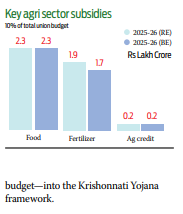
Regarding fertilizer subsidies, ₹1,16,805 crore has been allocated for urea subsidy, which is less than the current year's revised estimate of ₹1,26,475 crore. For non-urea fertilizers, ₹54,000 crore has been allocated, while expenditure is estimated at ₹60,000 crore in the current year. Thus, if we look at the budgetary provisions for agriculture and allied sectors, a clear trend is visible – the funds given to the ministries have not been fully utilised.
A Selective Expansion
A budgetary allocation of ₹8,500 crore was made for the Rashtriya Krishi Vikas Yojana in the current financial year. However, revised estimates suggest that actual expenditure will be limited to around ₹7,000 crore. For the coming year, the government has marginally raised the allocation to ₹8,550 crore.
In contrast, the Krishonnati Yojana has seen a significant upward revision. Of the ₹8,000 crore allocated in the current year, spending was initially projected at ₹6,800 crore. In the new budget, however, the allocation has been sharply increased to ₹11,200 crore. This jump is likely linked to the merger of the Pradhan Mantri Dhan-Dhanya Yojana—announced in last year’s budget—into the Krishonnati Yojana framework.
Natural Farming: Big Talk, Small Change
Natural farming has been one of the government’s most frequently invoked ideas, endorsed repeatedly from policy platforms to the Prime Minister’s Independence Day address. Yet the numbers tell a far less ambitious story. The National Mission for Natural Farming has been allocated just ₹750 crore—an amount that hardly signals a serious intent to scale up the programme nationwide.
Silence on Rural Employment
Equally striking was what the budget speech chose not to mention. Agricultural workers—among the most vulnerable sections of the rural economy—found no place in the Finance Minister’s address. The VB-G Ram Ji scheme, which is taking place of MNREGA, was not referred to at all.
While an allocation of ₹95,962 crore has been earmarked for the new scheme, concerns remain about how much of this amount will actually be spent. Under revised rules, the Centre will now bear only 60% of the cost, requiring states to contribute nearly ₹60,000 crore. Given the fragile fiscal position of many states, such a burden appears unrealistic, raising fears that actual spending will fall well short of the headline figure.
Cooperative Sector Gets Tax Relief
In contrast, the cooperative sector emerged as a clear beneficiary. The budget announced a series of tax concessions aimed at strengthening cooperative institutions. Primary cooperative societies supplying animal feed and cotton seed will now be eligible for tax deductions, provided supplies are made to government bodies or federal cooperatives.
Under the new tax regime, dividends paid by one cooperative society to another—known as inter-cooperative dividends—will also qualify for deductions, as long as these dividends are subsequently distributed among members. In addition, notified National Cooperative Federations will enjoy a three-year tax exemption on dividend income earned from investments in companies. This benefit, however, applies only to investments made up to January 31, 2026, and only if dividends are distributed to cooperative societies.
Farmers Call the Budget a Missed Opportunity
Farmer leaders across the country have reacted with disappointment. Raju Shetty, Maharashtra-based farmer leader, former MP, and president of the Swabhimani Shetkari Sanghatana, told Rural World that the budget ignores both farmers and the broader agricultural sector.
He pointed out that achieving selfsufficiency in pulses and edible oils should have been a priority, supported by stronger price incentives. Instead, the budget offers little by way of research funding or infrastructure development. To genuinely promote pulses and oilseeds, Shetty argues, farmers should have received a direct per-quintal incentive over and above the Minimum Support Price.
The All India Kisan Sabha (AIKS) echoed these concerns, saying Budget 2026–27 shows no real commitment to resolving the agrarian crisis. Cuts in fertilizer and food subsidies, the organisation warned, will only deepen farmers’ distress. It also noted that several long-standing missions— including the Cotton Mission, Pulses Mission, Hybrid Seeds programme, and the proposed Makhana Board—find no mention at all in the budget.
RNI No: DELBIL/2024/86754 Email: [email protected]