

Rural India still awaits basic infrastructure and services
The extensive discussions and insights gleaned from the five regional convenings, which collectively laid the foundation for framing the Agenda for Rural India, have prominently stated the need for bolstering and enhancing rural infrastructure.

Jonathan Donald Syiemlieh
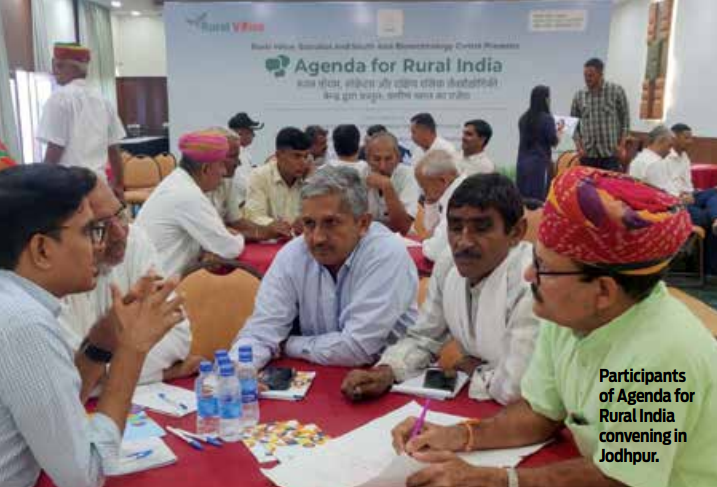
The extensive discussions and insights gleaned from the five regional convenings, which collectively laid the foundation for framing the Agenda for Rural India, have prominently stated the need for bolstering and enhancing rural infrastructure. This critical imperative extends to various sectors, including health and education, transportation and energy accessibility. The following are the findings related to challenges regarding lack of infrastructure in rural areas.
Rural Road Connectivity
More than one-fourth of the participants during the polling stressed the importance of improving road networks, footpaths, streetlights, and drainage systems throughout rural areas in Meghalaya. In both Meghalaya and Uttar Pradesh (UP), the consensus that emerged during the polling exercise highlighted a shared demand for the enhancement of high-quality road infrastructure, especially to connect farms and streamline transportation to and from agricultural markets (mandis).
Health Infrastructure
The state of healthcare in rural India has a direct impact on the lives and livelihoods of millions of rural residents. In both Uttar Pradesh and Meghalaya, participants voiced their concerns about the inadequacy of health infrastructure, including nonfunctional Primary Health Centers (PHCs) and Community Health Centers (CHCs). A significant number of participants in Uttar Pradesh, Odisha, and Meghalaya expressed that they would choose their future leaders if the promises made regarding the fulfillment of well-equipped, affordable, and easily accessible healthcare facilities (including hospitals and PHCs) were upheld.
Education Infrastructure
The state of educational infrastructure in rural India directly influences access to quality education and, by extension, the socio-economic development of the country. Rural youth in Uttar Pradesh do not receive adequate skills and technical education as echoed by a social worker from Muzzafarnagar , and the quality of primary and higher education in rural regions of Odisha, Rajasthan, Meghalaya, and Uttar Pradesh is deteriorating. A participant from East Khasi Hills, stated that ‘there is a high dropout rate across primary to middle school’ .
Furthermore, there is insufficient the market. In the case of fertilizers and pesticides, more is being applied every year. Farmers are unable to consistently fetch good and timely prices for their agricultural produce.
While costs have increased, the risks around farming have increased as well. Climate change is causing erratic weather including heat waves, rainfall, frost, pest attacks. Conversations around climate change have moved away from elite circles and are now a lived reality for everyone. It was discussed in great detail in every location. Human–animal conflict is increasingly manifesting itself and differently in different parts of the country. Stray cattle was the most critical issue in Uttar Pradesh, which has forced farmers to sleep in their fields. Animals are destroying crops in Odisha and in Rajasthan. Around Coimbatore, wild animal conflicts such as those with elephants are widespread and on the rise.
“Chemical ka atyadhik upyog sabse zyada barbaadi ka karan hai, gaon mein. Chemicals bahut zyada hai. Chahe woh zameen mein ho, janwaron mein ho, insaano mein ho. Har jagah chemical hi chemical hai.”
We were in Muzaffarnagar, a city in western Uttar Pradesh (UP). Along with Punjab, this region is at the heart of the green revolution in India. However, in a place like Muzaffarngar, the fact that the farmers themselves are bringing up the issue of overuse indicates how unbalanced the use of fertilisers and pesticides has become. “Nakli pesticide aa gayi hai – koi checking nahin hai.” “Dealer trade me lala log baithe hain jinko agriculture ka ABCD bhi nahin pata. Wo hume dawayian de rahen hain.” The critique of excessive chemical use was present everywhere we went. The narrative concerning natural ways of farming was surprisingly popular. Farmers are caught between the “natural” and “regular” farming narratives. Recurring and unexpected pest attacks need urgent attention for which solutions apart from using pesticides are not clear. The push for making farming sustainable and food healthy so that it works for both people and the planet is well and truly widespread, especially in Rajasthan and Odisha. In Muzaffarnagar and Coimbatore, farmers want to go focus on imparting practical skills, such as those related to agriculture. The poll promises that garnered votes from attendees in Odisha primarily centered on promoting farmer's education through training programs. Alternatively, in Meghalaya, a substantial portion of participants expressed their preference for election promises related to education infrastructure and achieving uniformity in delivering high-quality education up to the collegiate level.
Energy Infrastructure
Residents of Meghalaya, Tamil Nadu and Odisha have conveyed that power cuts and load shedding have had adverse effects on their daily lives, emphasizing the necessity for the state government to implement measures to ensure uninterrupted 24-hour electricity supply. In Uttar Pradesh, increasing electricity tariffs was cited as a concern by a farmer from Baghpat district. The participants in Odisha had stated that they would vote for leaders who would help promote and turn to renewable energy sources, particularly solar power, to reduce their reliance on fossil fuels. The development of energy infrastructure in rural areas of India is a crucial step toward achieving balanced, inclusive, and sustainable growth.
Conclusion
The insights shared by local communities, farmers, teachers, artisans, and others have provided invaluable contributions in shaping a rural India infrastructure agenda. By channeling investments into essential areas such as healthcare, education, transportation, energy access, we not only address immediate needs but also set in motion a series of transformative changes that profoundly impact the welfare of rural communities.
more “natural” but are unsure whether it will work and the risk appears too big for many. Overall, suggested solutions ranged from banning spurious pesticides, regulating dealers, educating farmers about balanced use of artificial inputs to going completely organic or leaning towards natural soil supplements.
Difference in aspirations and reality fuels labour shortage, unemployment and drugs
“Agar Bihar ke mazdoor na aaye, to aap kheti nahin kar sakte. Humne khud karni chod di hai.”
Be it Muzaffarnagar or Coimbatore, farmers everywhere complained that finding labour to work on the farms is a struggle. According to farmers, the wages for labour have become too high. And this is despite young people from the village not having any jobs. Young people would rather not do any work instead of labouring in the fields. As a result, land owners are dependent on migrant labour on many occasions. “MGNREGA ko kheti mein jodkar nuyntam mazdoori sunischit ki jaye. Jo sabse badi samasya hai humare rajnaitik tantra ki, woh hain 'freebies'.” The challenge of labour prompted a farmer from Baghpat to say that agricultural labour should be considered under Mahatma Gandhi National Rural Employment Guarantee Scheme (MGNREGS). As a result, the scheme would compensate for part of the labour cost. Another opinion among landowning farmers across regions is that the so-called “freebies” must be stopped. It is making people dependent on “handouts” and affecting their intent and availability to work.
Kisan se aaj kal koi shaadi nahin karta. Bacche AC me baithna pasand karen. The future of agriculture in India looks precarious not just because of the economic or environmental challenges mentioned, but because of a deep social challenge. Young people don’t want to do farming. Farming is not aspirational anymore. Men who continue to farm are finding it difficult to find brides. Society sees it as a dead end – backbreaking, uncertain and unremunerative. The likelihood of being pushed into debt with a bad harvest are high. As a result, young people, supported by their families, are completing higher levels of education. However, there are hardly any good jobs in villages except for the rare government ones. Nonfarm employment opportunities such as manufacturing, services, or smallscale industries are scarce. The blame for this is attributed to many factors: limited quality education in rural areas, absence of vocational training and lack of credit and infrastructure to enable rural industries to grow. The end result: young men and women, full of ambition and potential, are unemployed.
“Gaon nasha mukt hona chahiye, yeh sab ki prathmikta hai. Nasha nahi hona chahiye aur iske prati yuvaon mein jagrukta bahut zaroori hai.”
In 2016, the Hindi movie Udta Punjab brought the drug epidemic in Punjab to popular imagination. In 2023, it appears that drug usage is now not just limited to urban elites and regions of Punjab. Be it in Bhubaneshwar or Jodhpur, we heard the same thing : a large number of youth are consuming drugs across all social groups. Alcohol has long been a major problem in rural areas. It continues to be as we heard in Meghalaya, Tamil Nadu and Odisha. However, widespread consumption of drugs across India seems to have escaped the notice of the mainstream media. In the absence of a deeper understanding, one can hypothesize about the various causes for this epidemic. Is it due to joblessness – dreams colliding with stark reality? Is it because of popular songs and media making it “cool” and acceptable? Or is it because drugs seem to be more easily available? Joblessness, lack of engaging social institutions, increased desirability and availability of drugs is now seem to be fueling a drugs epidemic across India.
Village infrastructure still unable to provide basic services
People are still waiting for good quality basic infrastructure. People from the Garo, Khasi and Jaintia tribes in Meghalaya still need good road connectivity to enable movement of goods and people. Road connectivity has improved but not enough. And if roads are there, public transport is unavailable. The same goes for electricity. Constant electricity supply throughout the day is still a dream for rural India. The need for constant connection to the internet is also a necessity now. A farmer from Balotra (Rajasthan) is still in need of clean water for drinking, echoing the sentiments of people in the opposite corner of India, in Meghalaya, who also want tap connections. In Muzaffarnagar, farmers have water but are concerned about toxic chemicals and metals that have seeped into groundwater. There is a deep sense of being left behind when it comes to education in villages. The growing gap between government and private schools is gnawing at people. People want excellent public education. Even if the schools are there, the number of teachers is not sufficient. The government schools are considered ill-equipped to provide “quality education” that can lead to good careers for young people.
The need for good health and healthcare is increasingly felt across locations. With increasing lifestyle diseases, people need better treatment. Multi-speciality hospitals are far away from villages. Local health infrastructure leaves a lot to be desired. PHCs and CHCs are not sufficient and are illequipped.
“Engal gramathil suttamana sutrupuruchural, podukalaivarigal, vilayattu maidanangal, tirumsaranda payarchivaguppu vayyangal vendum.”
[In our village we want a clean environment, [...] places to rest, playgrounds, exercise facilities.] The older generations in the villages are seeing society changing. They feel the communitarian feeling is slowly fading away. Younger generations are seen as being occupied with their phones and have become distant from their villages, and their families. With changing diets and lifestyle, obesity rates among young people are increasing. With trees being cut down, because of often unplanned construction of roads and infrastructure, bringing with it an increase in vehicles and trash, traditional open spaces for public gatherings are not feasible options anymore. People don’t gather under trees and discuss life and politics. There is a felt need for clean, public spaces for the community. Spaces where people can rest comfortably, gather, talk and where young people can play and exercise. A place to have fun in the presence of others. To revive the village, this may be the easiest and the most important space to create.
Corruption in electoral politics and administration
“Sabse pehla vaada yeh ho ki vaada karne wala vaada nahi nibhaaye toh woh ek kanoonan apraadh ho. Aur iske liye sazaa ka pravdhan ho kyunki woh vaada karte hain, aap vote dete hain, woh chale jaate hain, phir agle paanch saal baad aaye hi nahi, toh baat hi khatam ho gayi” In Coimbatore, money and muscle in electoral politics emerged as a rallying point for rural citizens across various districts. One man at the convening in Coimbatore made the point that the legal apparatus is stacked against the agricultural farmer, and if an instance of corruption does come to light, the government officer must also bear their
RNI No: DELBIL/2024/86754 Email: [email protected]