

Indian Agriculture Needs A Holistic Policy Framework
For any observer of India’s economic progress, it should be obvious that India’s agricultural sector is steeped in crisis for the past several decades.

Dr. Biswajit Dhar
For any observer of India’s economic progress, it should be obvious that India’s agricultural sector is steeped in crisis for the past several decades. In 1950-51, agriculture’s share in the country’s GDP (including livestock) was 45%; the share of the workforce directly dependent on the sector was close to 70%. Seven decades later, agriculture’s share in GDP is just around 15%, but more than 42% of the country’s workforce depends on this sector. Unless this fundamental imbalance is resolved, agriculture will continue to be the Achilles' heel of India’s economic transformation story, which it has been for a long time now. It will, therefore, be impossible for India to catapult itself out of the ranks of lower-middle income countries it has been caught in for nearly a decade-and-a-half. Logically speaking, the incomeemployment imbalance in agriculture can be addressed through a sustained rise in agricultural incomes and/or reduction in the share of the workforce in agriculture. The National Democratic Alliance (NDA) government had focused on the former since 2016, setting the target of doubling farmers’ incomes by 2022. However, in the period since, no definitive policy initiatives were taken for realising this objective until the farm laws were introduced as ordinances in May 2020 and were enacted as laws by the Parliament, in record time. The three laws (henceforth farm legislations) are Farmers (Empowerment and Protection) Agreement on Price Assurance and Farm Services Act, 2020, the Farmers’ Produce Trade and Commerce (Promotion and Facilitation) Act, 2020, and the Essential Commodities (Amendment) Act, 2020. These farm bills sought to deregulate the agricultural markets for entry of big business by removing restrictions on trading, movement, and storage of agricultural products and by promoting contract farming. The narrative in support of the farm legislations spoke of another objective, namely, making India an agricultural export hub. This objective marks a fundamental shift in the policy orientation of the sector, as the primary driver for agriculture has always been the realisation of domestic food security and supporting rural livelihood.
Agriculture in India: Weighed down by structural constraints
One of the dismal realities of the agricultural sector in post-Independent India has been that it never experienced a high-growth phase unlike the non-agricultural economy. The highest decadal growth (compound annual growth rate or CAGR) for agriculture has been just 3.5% in the 1980s. Also, after experiencing a spurt in decadal growth during the 1980s, agricultural growth suffered relative stagnation thereafter. This is in sharp contrast to non-agricultural growth, which consistently increased between from the 1980s to the 2000s, before declining in the previous decade. This shows clearly that farming did not benefit from the process of economic reforms in the country.
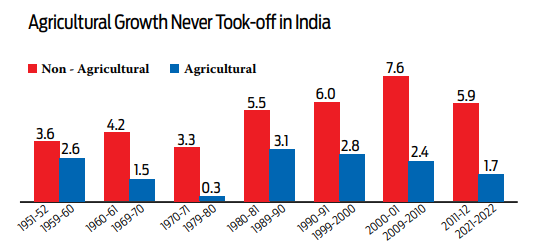
The slowdown in agricultural growth between the 1950s and the 1970s, coincided with a sharp rise in population growth. The decadal growth in population was 13.3% in 1951, but in the following two decades, it rose to 21.6% and 24.8%. The intersection of these two factors created significant levels of food insecurity, which manifested in growing import dependence on food grains. The phenomenon was also referred to as ship-tomouth existence, describing the eagerness with which the country’s citizens waited for the PL 480 shipments from the United States to land at India’s ports, for this alone could have helped limit starvation. It was this crisis which led to the central government launching of the Green Revolution in the late-1960s.
The gains from the Green Revolution were realised in the entire country only in the 1980s when agriculture overcame its low growth syndrome; registering the highest decadal growth of 3.5 % (the 2000s witnessed a similar level of growth). However, as shown in Chart 1, the gains through higher growth stagnated quickly. This trend in production has a direct bearing on stability of farm incomes. Indian agriculture was able to escape the throes of crisis in the mid-1960s through the technological interventions made through the introduction of the Green Revolution. The benefits of new technology in terms of higher output growth could not be reaped until the 1980s, and also that this growth could not be sustained in the following decades. This was largely because the spread of the green revolution technology was tardy and, therefore, did not extend the benefits, as described below.
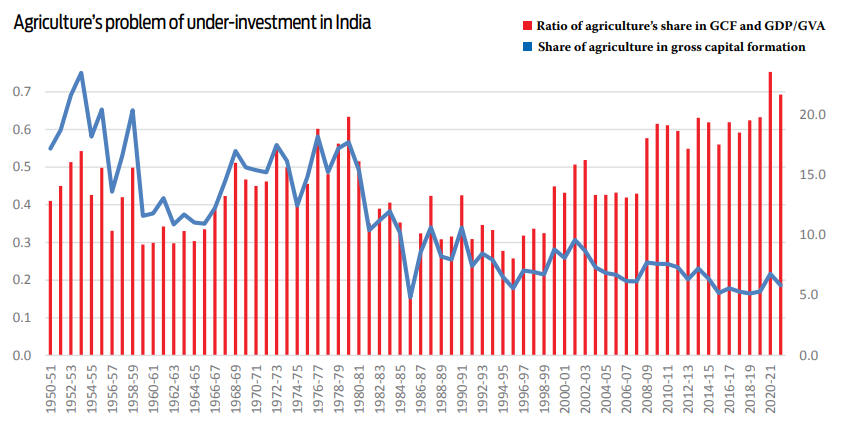
One of the major factors was inadequate sources of irrigation more than five decades after the Green Revolution technology was introduced. In 2019-20, 53% of the gross cropped area under principal crops was irrigated, increasing only by 6% in nearly a decade. The above-mentioned numbers are somewhat deceptive since there is considerable variation among States in the availability of irrigation facilities; some of the major States like Maharashtra, Madhya Pradesh and Karnataka were below the national average as regards coverage of irrigated area under principal crops during 2019-20. Of the 36 States and Union Territories for which data were available, in 25 States, coverage of irrigated area under principal crops was lower than the national average. Over the decades, agriculture has been receiving progressively smaller shares in the country’s capital formation. In the 1950s, agriculture’s share was nearly a quarter of the country’s overall investment; four decades later, the share had halved. Only after five more years, agriculture’s share had halved yet again. It was less than 6% in 2018-19, latest period for which data is available.
It narrates a story about the neglect of agriculture since the 1980s, the period in which successive governments have taken far reaching measures to introduce economic reforms. Clearly, none of the governments were inclined to initiate measures that could contribute to the improvement in productivity of the sector supporting the largest share of the country’s workforce. To be sure, one could argue that the decline in agriculture’s share in overall investment is a reflection of its declining share in the economy itself. The simple ratio of agriculture’s share in investment and its share in GDP, shows that there has been a disproportionate fall in agricultural investment in the country since the 1980s. While this ratio has always been less than one, which implies that agriculture is an investment-deficient sector, it has fallen further since the 1980s.
If inadequate investment, including in critical infrastructure, was adversely impacting agricultural productivity, the farming community faced yet another serious obstacle in that the market was not providing them the desired level of incentives. This can be gauged from the behaviour of barter terms of trade between agriculture and non-agricultural sectors. Agriculture has faced adverse terms of trade during the decade of the 1980s and again for most years since the mid-2000s. In the 1990s, when the terms of trade had turned in its favour there was an upward trend only in the first half of the decade, following which a declining trend had set in.
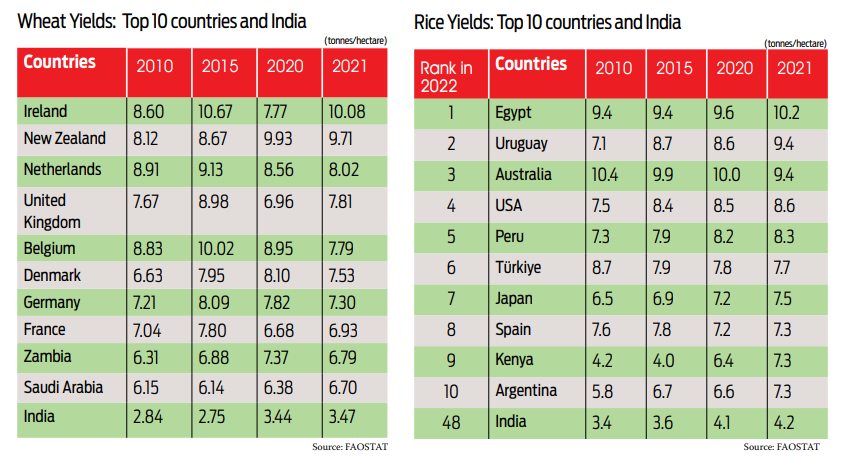
One could argue that unlike in the nonfarm economy, there is a limit to agricultural growth in any economy. Once all the land has been brought under cultivation and is being cultivated with the maximum possible intensity and the best possible technology, production cannot increase anymore. The evidence at hand suggests that India is still far from hitting this frontier. This is best seen from the fact that although India is among the top producers of all major food crops, it is considerably behind the countries having the highest levels of yields. The tables, providing details for wheat and rice, India's major food crops, show that not only have India’s yields in wheat and rice been considerably lower than those of the countries on top of the yield charts in recent years, but these have also been growing relatively slowly. Thus, India’s wheat yield in 2021 was more than three times lower than that of the country showing the highest yield, and in rice, the gap was slightly lower.
An otherwise disappointing headline numbers on productivity of food crops in India appear quite different when analysed regionally. A comparison of state-wise food grains yield brings this out clearly. Yields in Punjab and Haryana have, historically, been significantly higher than the all-India average. In the 2021-22 latest period for which data are available, food grain yields in Punjab and Haryana were 4.2 tonnes/ hectare and 3.9 tonnes/hectare as compared to just 2.4 tonnes/hectare at the all-India level. A further concern is that the two best performing states in terms of yields have been witnessing downward trends since the later half of the previous decade. It is pertinent to note here that all but 10 states in the country recorded food grain yields that are more than the national average. In 2021-22, these states accounted for nearly 56.5% of the production of food grains and less than 44% of the area under production.
Need for a Policy Reset in Agriculture
The most enduring set of policies that the government has adopted for the development of the agricultural sector since the mid-1960s have been an extensive subsidies regime. This followed the adoption of the “Green Revolution” strategy, which emphasized the necessity of providing the farmers with a “complete “package of practices” for increasing yields, including “credit, modern inputs and price incentives” in the form of assurance of MSP by the government for the major crops. At the same time, India maintained high levels of import tariffs, which it did to protect small farmers from import threats as well as to support its fragile balance of payments. However, the sector supporting the largest share of the workforce remained starved of investments.
With unabated increase in farm subsidies, two questions have repeatedly been asked. The first is the ability of the increasingly fragile government finances to support them. The second, and a more vexed set of questions have been asked in the World Trade Organisation. The subsidies disciplines introduced by the Agreement on Agriculture (AoA) stipulate that input subsidies, MSP, and a component of the expenditure incurred for operating the public distribution system (PDS) taken together, cannot exceed 10% Need for a Policy Reset in Agriculture The most enduring set of policies that the government has adopted for the development of the agricultural sector since the mid-1960s have been an extensive subsidies regime. This followed the adoption of the “Green Revolution” strategy, which emphasized the necessity of providing the farmers with a “complete “package of practices” for increasing yields, including “credit, modern inputs and price incentives” in the form of assurance of MSP by the government for the major crops. At the same time, India maintained high levels of import tariffs, which it did to protect small farmers from import threats as well as to support its fragile balance of payments. However, the sector supporting the largest share of the workforce remained starved of investments.
With unabated increase in farm subsidies, two questions have repeatedly been asked. The first is the ability of the increasingly fragile government finances to support them. The second, and a more vexed set of questions have been asked in the World Trade Organisation. The subsidies disciplines introduced by the Agreement on Agriculture (AoA) stipulate that input subsidies, MSP, and a component of the expenditure incurred for operating the public distribution system (PDS) taken together, cannot exceed 10% of India’s value of agricultural production. Besides, subsidies granted to individual crops also cannot exceed 10% of their value of production. Several WTO members, including the United States, Canada, Australia, and the European Union, have argued that India has been violating its subsidy commitments in respect of several crops. In a significant submission to the Committee on Agriculture in 2018, the United States had claimed that the MSP that India provides to rice was consistently above 70% of its value of production since 2010-11 and that for wheat, this figure was above 60% during the same period.
A second challenge facing India’s subsidies’ regime has emerged from the suggestions made to the government to amend the country’s subsidies regime. The most significant of these came from the “High Level Committee on Reorienting the Role and Restructuring of FCI”. The Committee had recommended in its report in 2015 that India should provide direct income transfers to farmers, on which the AoA does not impose any spending limits by the government. It may be mentioned that direct income transfers have at least two implementation problems. First, three types of cultivators are engaged in agriculture, namely, owner cultivators, tenants/sharecroppers, and landless labour, and therefore payment of subsidies can be a vexed issue. Secondly, given the large number of holdings (over 146 million in 2015-16), implementation of direct income transfer could be a strain on the administration.
The above discussion makes it clear that agricultural policy in India needs a serious re-think. There is an urgent need to engage with the farming communities for adopting a comprehensive set of policies, which include setting up of farmer-friendly institutions in order to improve the economic viability of the sector. This can happen only if there is a mindset change in the government, above all, the willingness to develop agriculture as a national priority. The government needs to recognise that most farmers do not regard agriculture as a viable occupation, a situation that can only be altered through enhanced investments in physical infrastructure and creating institutions that respond to the needs of the low income and resource poor farmers. If, according to the government’s own assessment 99.43% of farm holdings are held by this group of farmers, the crisis faced by Indian agriculture is truly monumental.
RNI No: DELBIL/2024/86754 Email: [email protected]