

Agriculture needs hand holding Existential Crisis For Rural India
Indian agriculture faces an existential crisis with the entire rural landscape in the grip of societal and environmental challenges despite, a visible improvement in infrastructure like roads, sanitation and mobile phones.
Harvir Singh

Prachur Goel
Indian agriculture faces an existential crisis with the entire rural landscape in the grip of societal and environmental challenges despite, a visible improvement in infrastructure like roads, sanitation and mobile phones. You might ask: Is it a paradox of sorts then ? The answer is 'Yes' and based on a six-month-long direct interaction with the critical stakeholders like farmers' organisations, civil society, policy makers and market intermediaries not in New Delhi or metropolitan cities but in the states bottom up to smaller towns in five states with a wide diversity in agri-climate, economic strength, and crop patterns
Our findings after this comprehensive interaction, converted into measurable data , would give you an impression about the state of agriculture which may not be in conflict with an assessment of a bureaucrat in New Delhi or a state capital but is a holistic view of the rural landscape that needs effective policy intervention and political support right now than later.
If you talk to senior government officials in New Delhi, they would tell you there has been a significant progress in terms of new roads built, electricity connections or the houses and toilets constructed. They might highlight how mobile phones have become common in rural areas and how there is a growing marketfor all sorts of products and services.
Indeed, rural India has seen many changes. Things like infrastructure (roads, electricity connection) and access to various services have definitely gotten better thanks to different schemes of the Centre and the state governments. But these visible physical infrastructure facilities lead to rising aspirations of those living in villages and small towns to be at par with those in cities even as the pureplay agriculture, the core, is at risk of being left on its own. By the way, the aspirations of rural India are quite reasonable and doable, provided there is a political will and the menace of corruption is dealt with effectively.
Risks to the core of rural India, that is agriculture, as highlighted in our cross-country interaction include high level of debts, unabated rise in input costs including increasing labour wage , indiscriminate sale of spurious pesticides , perilous risks of climate change and wild gyrations in prices of the harvest, coupled with a political apathy.
“Plastic mukt, paryavaran yukt, nasha mukt, wifi yukt. Parivahan suvidha sahit, pradushan rahit, 24 ghante bijlee aur ek stadium ho jismein ladke, ladkiyan, mahilayen roz daude. Adhunik shiksha aur swasthya ho aur krishi sambadhi jaankari vigyaan ke aadhar par mile.”
“Humare gaon hare bhare ho, jalstrot pariyapt ho aur shudh ho. Saaf suthre gaon ho, plastic mukt ho. Vidyalayon mein ladke, ladkiyon ki sankhya khub badi ho, khaas kar sarkari sansthaon mein.”
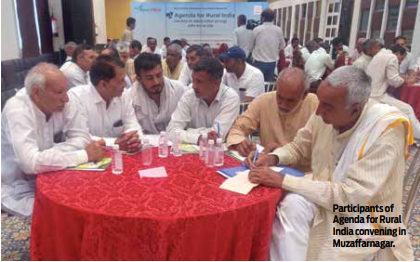
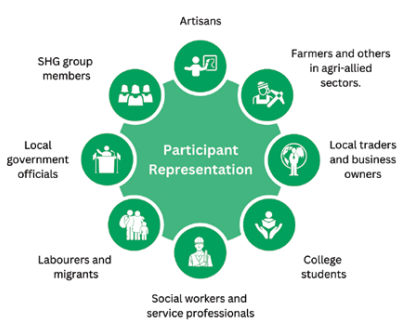
This is what we heard when we asked people from Balotra, Barmer, Jaisalmer, Sikar, Nagaur and other districts of Rajasthan, who were gathered in Jodhpur, “2030 me aapka gaon ka sapna kya hai?”. People in rural India have a dream – they want their villages to have the same facilities as cities. They hope for better education, healthcare, roads, electricity, and other things that make life comfortable and convenient, just like what people in cities have, at least some of them. If they have all these things, they believe they could live much better lives.
The rural idyll of a peaceful, pollution-free village where everyone had work to do is far from reality. Rural life has changed, and it's not what it used to be. Many rural areas still lack basic facilities like reliable electricity, good roads, clean water, quality education, and healthcare. People are struggling, and farming is no longer a viable occupation for many – neither in terms of income nor social status. Moreover, rural inhabitants are facing new problems like climate change, pollution, lifestyle diseases, unemployment, and drug issues. These are problems that used to be thought of as city problems, not rural ones.
When Rural Voice, a sister publication of Rural World and Socratus, a non-profit organization, decided to embark on a first-of-itskind pan-India convening series with citizens from rural India in order to hear their challenges and aspirations, it was driven by two main motivations. One, rural areas are often marginalized in mainstream discourse. In the news, rural areas are hardly present in the
RNI No: DELBIL/2024/86754 Email: [email protected]