

Agriculture: Difficult Harvests
No discussion on rural India would be complete without a conversation on agriculture.

Adrija Chaudhuri
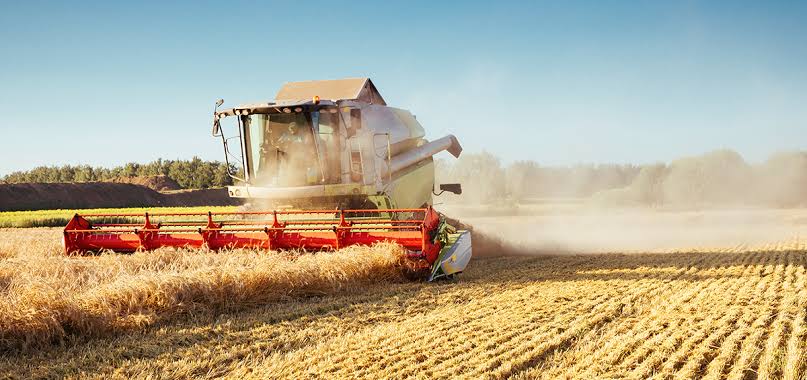
No discussion on rural India would be complete without a conversation on agriculture. In our convenings with rural citizens across the country, around 60% of our participants were farmers, by which we mean they were involved in agricultural activities for their livelihood. The reality of the agrarian crisis plaguing rural communities for the past two decades was painfully evident in the worries, hopes and dreams of our participants. While most of the issues they raised were not new, it was illuminating to understand the perceptions and priorities of the farmers themselves.
Everywhere we went, farmers told us that it was becoming almost impossible to sustain themselves through agriculture alone. Crop prices were simply unable to keep up with the costs of farm inputs. As a young farmer from Western UP told us: “Aur sab itni costly hote ja rahi hai bohot zyada.....har tarah se pressurise kar diya hai” [Everything is becoming so costly, including fertilizers and pesticides, that we are being pressured from all sides] In Muzaffarnagar, part of the “sugarcane belt” of North India, the stagnation of the SAP (State Advised Price) and delay in payments from the sugar mills were common problems. Farmers here also complained of the rising cost of basic necessities and farm inputs, including pesticides, fertilizers, seeds and labour. Even in this relatively prosperous agrarian belt, farmers were being forced to take loans to continue farming. It was telling that no farmer wanted their children to become farmers and there were hardly any takers from the younger generation as well.
In Odisha, farmers felt that crop prices were hardly remunerative and that the root causes of poor price realization were the difficulties in accessing markets and the lack of market infrastructure. As a farmer from Kendrapara district said: "The main reason for the poor price received by farmers was the lack of storage facilities like warehouses and cold storages.” Most farmers were forced to sell their produce directly at the farm gate to local traders and middlemen. This happened due to poor transportation facilities and the lack of warehouses and cold storages in which to store their produce. In the very different arid agroecological zone of Rajasthan, farmers raised similar issues of the lack of storage facilities and marketing opportunities. They told us how crop prices were unable to keep up with the rising costs of farm inputs such as seeds, fertilizers and pesticides, which ended up squeezing their profits. In Shillong too, we heard the same story: poor price realization due to inferior road connectivity, lack of storage facilities and delayed payments. In Coimbatore, farmers felt that the MSP (Minimum Support Price) was too low and that it should be decided by the farmers themselves. They suggested that MSP should be extended to crops commonly grown in Tamil Nadu, such as tea, coffee, vegetables, millets and spices.
In many of our events, there was also a perception that the MSP and good prices alone could not address the issue of decreasing viability of agriculture. Farmers everywhere voiced their People from different occupations participated in the convening. There were artisans, local traders and business owners, SHG group members, local elected officials, local government officials, labourers and migrants, college students, social workers, and service professionals. Care was also taken to ensure that people across gender and social groups were in attendance.
Design of the convenings
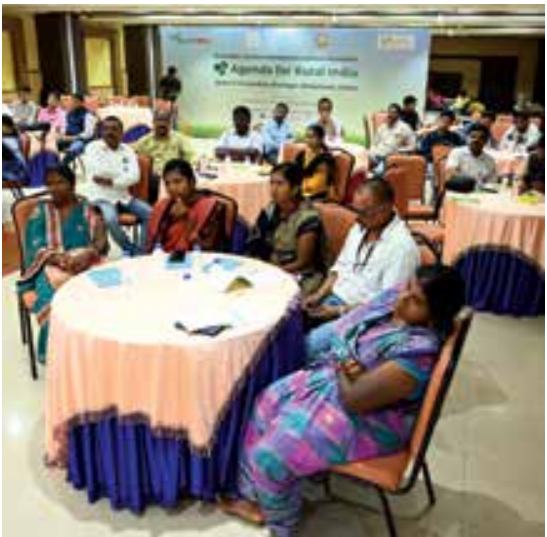
Group deliberation and negotiation The format of the convenings was similar in all the regions. It included both group discussions and individual voting. To start, we had everyone introduce themselves to make everyone more comfortable. Then, we divided the participants into different groups with a mix of people. Each group talked among themselves and picked out the five biggest problems in their community. Afterward, each group shared these issues with everyone in the room.
The idea behind this approach was to encourage the participants to express their thoughts and feelings. We wanted to create a space where people could have discussions and come to an agreement on the most important ideas. Following this, the groups discussed hopes they had for their villages. Groups also figured out the top five things they wanted their candidates to promise in an election.
The important process here was that participants discussed their problems with others and then decided together which issues were most crucial. This way, they had to talk and negotiate with people who had different perspectives, and they worked together to find common ground.
Our role as facilitators was to help this process happen without trying to influence what the participants expectations that governments would secure their incomes under schemes such as PM-KISAN. They also suggested that value-added products and local industries in agriculture should be actively supported and encouraged by governments. Farmers felt the capacities of collective organizations such as FPOs and cooperatives should be enhanced to take on this responsibility. In all our convenings, we also heard that landowning farmers were unable to source labour for their fields, and that they were increasingly relying on migrant labour for cultivating their farms. They suggested that agricultural work should be provided under MGNREGA, and that the wages could be jointly paid by the farmers and the government, thereby also ensuring a higher wage rate.
This brings us to the matter of government schemes on agriculture. The lack of awareness about such schemes, due to which they were not reaching those who were in need, seemed to crop up in every location. This was felt strongly by our participants from Rajasthan, who suggested that information about government schemes should be displayed outside all government offices. In Meghalaya, farmers felt that they should have better information on and access to government schemes on agriculture. In Odisha, participants were dismayed at the delayed or lack of implementation of government schemes such as MGNREGA. Another issue that came up with striking regularity was the overuse of chemical fertilizers and pesticides. While this is a widely accepted problem amongst agricultural scientists and experts, it was interesting to note that the level of awareness among farmers regarding this issue was also quite high. In Odisha, farmers told us that these harmful chemicals were leaching into and polluting water sources as well, including groundwater. In Rajasthan, we heard the concern in their voices about how excessive chemical use was causing cancer and other diseases in rural areas. They felt trapped in systems that encouraged the overuse of chemicals. Farmers also prioritized a concern that does not figure prominently in the discourse on agriculture: human– animal conflict. In UP, farmers were afraid to even plant crops due to the stray cattle menace. In fact, it was the issue that resonated the most among our participants in Muzaffarnagar. Farmers suggested several solutions, ranging from using government funds to build cattle shelters in every village to a monthly payment for farmers to care for their old cattle, to legalizing the cattle trade. In Odisha, Tamil Nadu and Meghalaya, wild animals from the forested areas nearby often entered their fields, destroying crops and endangering the safety of the farmers themselves. As a farmer from Coimbatore district told us: “In the division along the western ghats, from Tenkasi to Satyamangalam forest division, millet crops can't be grown due to deer nuisance, pig nuisance and peacock nuisance”. A farmer from the Nilgiris foothills even carried a photo album documenting the damage in his area. The farmers believed that illconceived government conservation schemes were to blame for this rise in human–animal conflict.
We cannot close this section without mentioning an issue that is vital to agriculture: water. Water for irrigation was a concern everywhere, but especially in Odisha and Rajasthan, two contrasting agroecological regions. In Rajasthan, the declining quality of groundwater due to overuse of chemicals made good irrigation facilities vital to the future of farming.
said in any way.
In a democracy, people turn their opinions into political choices by voting. In India, how someone votes is influenced by their own thoughts and also by the views of the community they belong to.
As a part of our last activity, we asked the participants to tell us about the most important issues that would affect their vote in both state and national elections. This was something they did on their own. In the past, we've noticed that Indian voters sometimes choose different parties between the state and national elections. We wanted to see if this pattern still held true. Farming faces existential economic, social and environmental crisis “Kisan to khush-haal hai hi nahin. Hundred percent kisan, karzdaar hua baitha.” Costs of living have gone up and in the absence of commensurate increase in income from agriculture, farmers end up accumulating substantial debt. The costs of inputs have gone up – from seeds to labour, fuel to pesticides. All of them now need to be bought from
RNI No: DELBIL/2024/86754 Email: [email protected]