
From Fields to Future: Agriculture is Powering India’s Growth Story
While adversity has tested India before, the Covid-19 crisis was an ordeal unlike any other, straining both society and the economy. It was agriculture and the rural economy that bore the nation’s weight during those uncertain times.

Harvir Singh

While adversity has tested India before, the Covid-19 crisis was an ordeal unlike any other, straining both society and the economy. It was agriculture and the rural economy that bore the nation’s weight during those uncertain times.
Food security never faltered—thanks to resilient farmers and uninterrupted agricultural activity. Abundant food grain reserves allowed the government to extend free provisions to millions, ensuring no one was left behind.
The experience underscored a vital truth: agriculture is no longer just the backbone of survival, but a driver of India’s economic trajectory. As the nation aspires to become a five-trillion-dollar economy, a full trillion is projected to emerge from agriculture and allied sectors.
To achieve this, however, status quo policies will not suffice. Structural reforms, greater investment, technological infusion, and accessible resources are essential to unlock the sector’s full potential.
Hastening this process is the global trade war unleashed on us by forces beyond our control. These may well force us to lower our tariff guards on many counts, again testing the resilience of India’s farmer community as also their spirit of innovation.
It is in this context that the Viksit Krishi Sankalp Abhiyan was launched during the recent Kharif season. Spearheaded by Union Agriculture and Farmers’ Welfare Minister Shivraj Singh Chouhan, the initiative seeks to bridge gaps between farmers, scientists, and policymakers, creating a nationwide dialogue.
In its first phase, spread across May and June, the campaign touched nearly 13.5 million farmers in more than 100,000 villages through 60,000-plus programs—covering every agro-climatic zone and major crop. A second phase will follow for the Rabi season in October.
While its impact will take time to materialize,the Abhiyan has already brought grassroots issues to the fore, assuring cultivators that their concerns are being directly heard by policymakers. For the government, it has created a platform to reset priorities.
For farmers, it has opened a channel of confidence. Importantly, since agriculture remains a state subject, the campaign is also knitting closer coordination between the Centre and the states.
Complementing this initiative is another landmark move: the unveiling of the National Cooperative Policy 2025, the first in 23 years. India’s cooperative movement has been central to empowering agriculture and the rural economy, giving farmers collective strength as an economic force.
While models like Amul and IFFCO stand as shining successes, the movement has also seen many setbacks. The new policy aims to infuse the sector with transparency, good governance, technological integration, and professional management.
It also envisions primary cooperative societies expanding beyond agriculture into diversified business activities—making cooperatives more attractive to the younger generation.
The true measure of success, however, will depend on effective implementation and the willingness of states to cooperate, since primary cooperative societies fall under their jurisdiction.
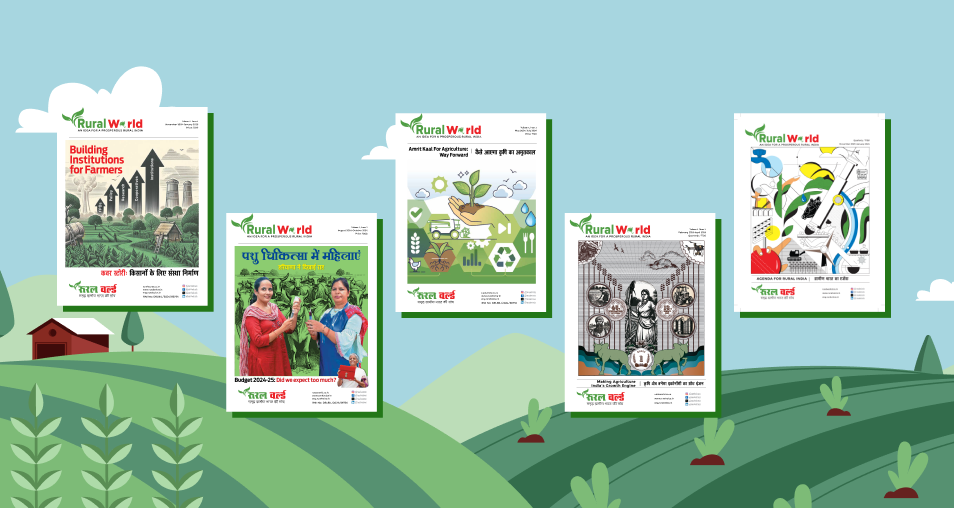
In this issue of Rural World, readers will find an in-depth analysis of the new cooperative policy, insights from Devendra Kumar Singh, Chairperson of the Cooperative Election Authority, and an exclusive conversation with Dr. Chandrapal Singh, Chairman of KRIBHCO, on the policy’s significance and the International Year of Cooperatives 2025.
Agriculture has always been India’s anchor in times of crisis. Now, with renewed policy focus, dialogue, and cooperative strength, it has the potential not just to secure food for the nation—but to propel it firmly into the future.
RNI No: DELBIL/2024/86754 Email: [email protected]